Download
1 / 12
120 likes | 237 Vues
This study investigates the Pacific Decadal Oscillation (PDO) using the CCSM3 Large Ensemble Experiment, focusing on data from a historical run (1870-1999) and a 30-member A1B scenario (2000-2061). We analyze atmospheric and oceanic responses to decadal sea surface temperature (SST) anomalies, with insights drawn from complex empirical orthogonal function (EOF) analyses. Findings suggest decadal predictability in the early years of the ensemble, highlighting the roles of horizontal temperature advection and surface heat flux while noting the limited role of the deep ocean. Further studies on air-sea coupling are necessary.

E N D
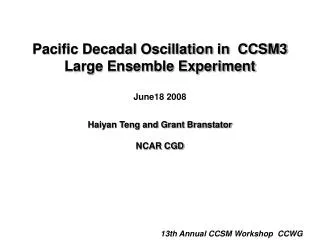
Pacific Decadal Oscillation in CCSM3 Large Ensemble ExperimentJune18 2008Haiyan Teng and Grant BranstatorNCAR CGD 13th Annual CCSM Workshop CCWG
CCSM3 T42 Large Ensemble Experiment CCSM3 Large Ensemble Experiment • T42 • One historical run 1870-1999 30-member A1B scenario, 2000-2061 • ocn/lnd/ice same initial data; atm 1999-12-03 to 2000-01-14 • Bassi, Bluesky, Bluevista, Blueice • CCSM CVWG & CCWG • Data post processed & published at ESG (Gary Strand) • Ongoing projects: CVWG webpage, or contact Adam Phillips
Obs • Mechanism of PDO • Atmospheric noise? • Hasselmann (1976) • Frankignoul and Hasselmann (1977) • …… • Atm-ocn coupled mode? • Latif and Barnett (1994, 1996) • Neelin and Weng (1999) • Kwon and Deser (2006) • …… • Atm response to the decadal • SST anomalies? CCSM3 Alexander et al. (2006): PDO lacks connections to the Tropics in CCSM3 The mechanism of the decadal SST variability is important for decadal climate prediction. http://www.jisao.washington.edu/pdo/
0-300m annual mean ocean temperature at 140°E-200°E, 40°N-50°N
Complex EOF Analysis monthly 10-20yr filtered SST from 900-yr CCSM3 T42 PDcntrl run CEOF1(40%) amplitude 180° phase ~ 70 episodes -180°
Probability density function of the PDO phase in the 30 members N=20 N=10
Ocean Temp at 40°N: Composite (shading) & Climatology (contour)
Upper 300m ocn TEMP composite based on CEOF temporal phase
Ocean top 300 m heat budget T/t =- V·T +w_adv@300m+ Sur_flx phase T+1- T -180° -150° -120° -90° -60° -30°
300m/curl() composite based on CEOF temporal phase (~70 cases)
Summary • Some decadal predictability is suggested in the first ten years in the large ensemble experiment • The decadal ocean temperature anomalies are mainly caused by horizontal temperature advection and surface heat flux. The deep ocean doesn’t play an active role. • The air-sea coupling needs to be further studied.