Naming Binary Ionic Compounds
This guide provides a comprehensive overview of binary ionic compounds, which consist of two different elements. It explains the naming convention, where the name ends with the suffix "-ide," as seen in examples such as sodium chloride (NaCl) and magnesium chloride (MgCl2). The guide also details the process of writing chemical formulas using the "cross-over" method to ensure balanced charges between cations and anions. Additionally, it highlights the distinction between ionic and non-ionic compounds to aid in understanding chemical bonding.

Naming Binary Ionic Compounds
E N D
Presentation Transcript
A binary compound involves just two different elements and the name usually ends with the suffix “-ide”. • Examples are NaF, LiBr, Hg2Cl2, nickel bromide, sodium chloride
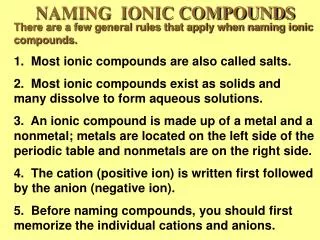
We know that ionic compounds are formed when cations (formed from metals) bond with anions (formed from non-metals). • Ionic compounds: AuCl3, NaCl • Not ionic: CO2, PCl3, SiO2
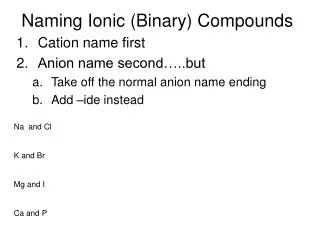
Naming Ionic Compounds • To write the name of a binary ionic compound, follow these steps: • write the name of the metal • write the root for the non-metal with the ending –ide Example: NaCl is sodium chloride Fe2O3 is iron oxide
Sometimes you’ll be given the name of a compound and you will have to come up with the formula. This is a little more work as you will have to consider the charges on the ions. • It is important to remember that even though ionic compounds are made up of cations and anions, the net charge on the compound is zero. For example, in NaCl, the Na is +1 and the Cl is –1. They combine to make zero.
One way to make sure that a formula you write has balanced charges is to use the “cross-over” method. Follow these steps: • write the formulas of the ions beside each other • cross over the number of the charge on the cation so that it becomes the subscript for the anion • cross over the number of the charge on the anion so that it becomes the subscript for the cation
Example of “Cross-over” Method • To determine the formula for magnesium chloride: Mg+2 Cl- MgCl2