Download
1 / 11
110 likes | 221 Vues
Explore the impact of MLK, Birmingham events, Freedom Rides, desegregation protests, and Kennedy's role in the Civil Rights Movement of the 1960s, including implications for today’s society.

E N D
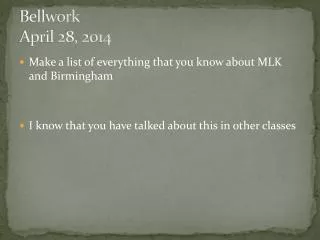
Bellwork April 28, 2014 • Make a list of everything that you know about MLK and Birmingham • I know that you have talked about this in other classes
Growth • New wave of activity began to sweep across the nation on the 1960s • Segregation was in both the North and the South • Whites and African Americas lived in different neighborhoods • Children attended different schools • Activists began to spread the goal of combatting discrimination and racism in the North
Sit-in • High School and College students staged 80 sit-ins • Against stores that practiced segregation • Wanting to end the disruption to the businesses, store managers agreed to desegregate • Student Nonviolent Coordinating Committee (SNCC) • Launched by sit-ins • Lead by Ella Baker
Freedom Rides • Congress of Racial Equality (CORE) • Wanted to guarantee that the Supreme Court order to desegregate buses was being enforced • May 4, 1961 • Group of African American and White CORE members left D.C. on two buses bound for New Orleans • Called themselves Freedom Riders • Went smoothly until Alabama • Angry whites stoned and beat the freedom riders • Robert Kennedy asked CORE to stop for a while for a “cooling off period” • James Farmer responded “we have been cooling off for 350 years. If we cool off any more we will be in a deep freeze”
Violence • Freedom Riders continued and met more violence in Birmingham and Montgomery • Jackson, Mississippi • National Guard units were waiting • As the Freedom Riders left the bus and tried to enter the whites-only room they were arrested for trespassing and jailed • Despite this they kept going all summer • Interstate Commerce Commission took steps to ensure enforcement of the Supreme Court ruling • Banned segregation on interstate buses and in bus stations
Universities • African Americans continued to apply pressure • Spurred Kennedy to take a more active role • 1962- Federal Court Ordered the University of Mississippi to enroll its first African American student, James Meredith • Governor Ross Barnett, with the aid of the state prevented Meredith from enrolling • Kennedy sent federal marshals to escort Meredith to the campus • Riots erupted
Universities • Mob stormed the administration building armed with guns and rocks • Marshals fought back with tear gas and night sticks • Meredith was registered • 2 people were killed • Federal troops were stationed at the university to protect him until he graduated in 1963
Universities • June 1963 • University of Alabama in Tuscaloosa • Governor George Wallace • Vowed to stand in the school house door to block integration of the university • Kennedy sent out the Nation Guard and Wallace backed down
Birmingham • Spring 1963 MLK and SCLC targeted Birmingham for a desegregation protest • Police arrested hundreds of demonstrators, including King • Demonstrations continued • During his 2 weeks in jail, King wrote “Letter from Birmingham Jail” • Police set snarling police dogs on unarmed demonstratorsand washed small children across the street with powerful fire hoses • Kennedy sent 3,000 troops to restore peace
June 11, 1963 • Jackson, Mississippi • Medgar Evers • State field secretary for the NAACP • Murdered • The events in Alabama and the murder forced Kennedy into action • Appearing on T.V. he spoke of the “moral issue” facing the nation • Day later Kennedy introduced new legislation giving all Americans the right to be served in public paces and barring discrimination in employment
Closure #5 • Imagine you were present for the violent protests that we discussed today: • How would they make you feel? • How would you react? • Would you have been a bystander or a demonstrator? • Do you think something like this could happen today? Why or Why not?