Download
1 / 5
60 likes | 176 Vues
This study guide covers key concepts of continuity, the Intermediate Value Theorem (IVT), and end behavior in polynomial functions, essential for preparing for quizzes and exams. It includes examples of function intervals, points of discontinuity, and detailed analyses of function behaviors across specified ranges. Important features such as domain, range, zeros, y-intercepts, and local extrema are highlighted. The guide emphasizes that polynomials are continuous everywhere, and it provides solutions to various problems related to these topics.

E N D
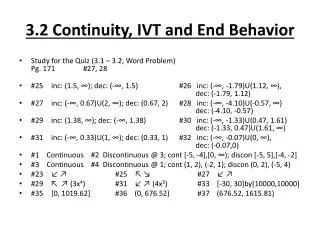
3.2 Continuity, IVT and End Behavior • Study for the Quiz (3.1 – 3.2, Word Problem)Pg. 171 #27, 28 • #25 inc: (1.5, ∞); dec: (-∞, 1.5) #26 inc: (-∞, -1.79)U(1.12, ∞), dec: (-1.79, 1.12) • #27 inc: (-∞, 0.67)U(2, ∞); dec: (0.67, 2) #28 inc: (-∞, -4.10)U(-0.57, ∞)dec: (-4.10, -0.57) • #29 inc: (1.38, ∞); dec: (-∞, 1.38) #30 inc: (-∞, -1.33)U(0.47, 1.61)dec: (-1.33, 0.47)U(1.61, ∞) • #31 inc: (-∞, 0.33)U(1, ∞); dec: (0.33, 1) #32 inc: (-∞, -0.07)U(0, ∞), dec: (-0.07,0) • #1 Continuous #2 Discontinuous @ 3; cont [-5, -4],[0, ∞); discon [-5, 5],[-4, -2] • #3 Continuous #4 Discontinuous @ 1; cont (1, 2), (-2, 1); discon (0, 2), (-5, 4) • #23 ↙ ↗ #25 ↖ ↘ #27 ↙ ↗ • #29 ↖ ↗ (3x4) #31 ↙ ↗ (4x3) #33 [-30, 30]by[10000,10000] • #35 [0, 1019.62] #36 (0, 676.52) #37 (676.52, 1615.81)
3.1 Graphs of Polynomial Functions Information from a Function Find all the information for: • End behavior type • End behavior model • Determine domain and range • Determine all zeros • Determine y – intercept • Determine all local min/max values • Determine intervals of increasing/decreasing • Draw a complete graph
3.2 Continuity, IVT and End Behavior Points of Discontinuity Examples • A function f has a point of discontinuity at x = a if on of the following conditions hold: • The function is not defined at x = a • The graph has a break at x = a • The graph has a hole at x = a
3.2 Continuity, IVT and End Behavior The cool thing about polynomials… they are continuous EVERYWHERE!!!
3.2 Continuity, IVT and End Behavior Intermediate Value Theorem (Property) Example For f(x) = 9 – x2on the interval [0, 3], will there be a c such that f(c) = 8? For f(x) = 2x3 – 11x + 12x + 5 on the interval [-1, 3], will there be a c such that f(c) = 6? • If a function is continuous on [a, b], then f assumes every value between f(a) and f(b). • If f(a) < L < f(b), then there is some number c in [a, b] such that f(c) = L.