
Cutting-Edge Metallic Glass: Revolutionary Material for Diverse Applications
E N D
Presentation Transcript
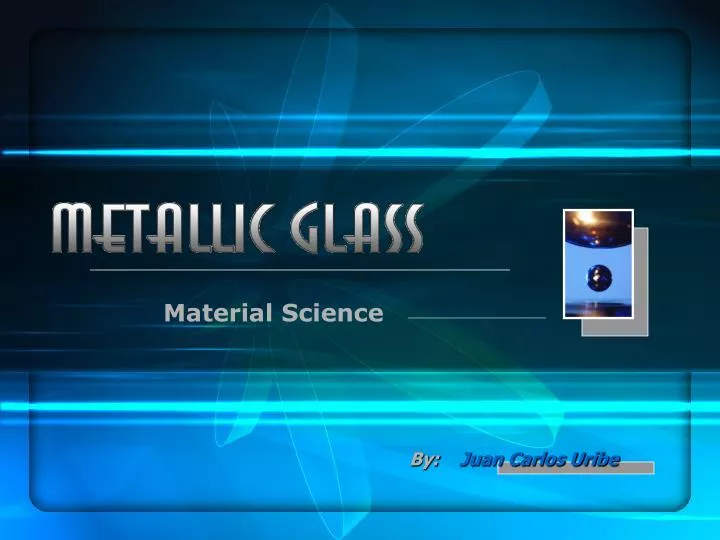
Material Science By:Juan Carlos Uribe
Non-crystalline, amorphous structure • No dislocations • No grain boundaries • High elastic limit • High strength
Metals used: Zirconium Beryllium Titanium Copper Nickel Discovered (1960’s) California Institute of Technology William L. Johnson Atakan Peker
Golf clubs • Fishing rods • Car bumpers • Aircraft skins • Artificial joints • Dies • Cutting tools • Others
Small dimensions (due to cooling) • Raw materials expensive • Approx. from $500 per pound • Production expensive
HOT SPARKS FLY FROM A NOTCHED SAMPLE OF BULK METALLIC GLASS FRACTURED BY A BLOW FROM A PENDULUM FRACTURED SURFACE SHOWS EVIDENCE OF LOCAL MELTING
REFERENCES • http://www.lbl.gov/Science-Articles/Archives/spaparking-metallic-glass.html • http://www.mat.ethz.ch/about_us/material_world/success... • http://www.eurekalert.org/pub_releases/1998-03/ • http://science.nasa.gov/headlines/y2003/14apr_zeroglass.htm • http://www.eng.auburn.edu/~wfgale/intro_metals/section3pg2.htm