Download
1 / 11
110 likes | 247 Vues
Shanghai faces severe air pollution due to its vast population, rapid industrialization, and reliance on coal for energy. Major sources include transportation, industrial emissions, and power generation, leading to alarming health statistics, including a 60% increase in lung cancer rates. Current measures involve shutting down factories, regulating vehicle emissions, and enhancing green spaces. This research outlines the pressing need for effective pollution control and the implementation of ecological progress to safeguard public health and the environment.

E N D
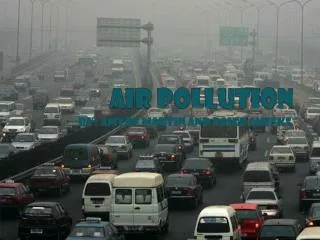
Air pollution in Shanghai • Geography - Group 9 A research done by : Lim Si Heng : David Yao Yifan : Yoong Wei Jue : Nicholas Lim Jing Wei
Contents • Causes • Impacts • Measures • Other relevant information
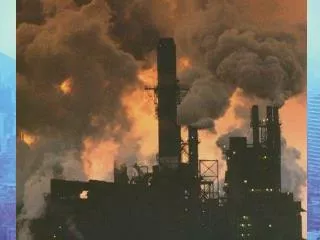
Causes • Shanghai has a huge population transportation vehicles release a lot of harmful gases • Rapid industrialization in Shanghai has caused smogs to be released • Industrial worksites, power plants and metal smelters spew a lot of carbon, metals, gases and soot into the air
Causes • Majority of the air pollution is caused by the burning of coal to generate electricity • Lack of other energy sources thus burning of coal is the only way to generate resources
Impacts • Rate of people obtaining lung cancer has increased by 60% • Smoking rates have stayed the same but rate of people obtaining cancer is still increasing • Causes respiratory problems as the air pollution is not easily blocked by masks and coughed out
Impacts • People are more inclined to buy masks and air purifiers but their methods are ineffective • Affects mortality as indoor and outdoor air pollution could be fatal • Air in Shanghai corrodes airplanes’ engines thus they need to be changed regularly • Total health care costs have increased, accounting for 3.3% of China’s gross domestic product
Measures • Temporary shutting down more than 100 factories • Officials ordering 180,000 vehicles off the road • Growing trees over 250 square miles of land in the next five years • Optimize industrial structure, promote energy saving and emission reduction, and advance ecological progress
Measures • Direct regulation and rigorous technology standards, such as mandatory scrubbing of power-plant emissions pollution-control standards for automobiles • Permit-trading programs for sulfur emissions, in order to reduce the cost of pollution abatement • Fuel tax • Polluting industry will have stricter emission limits
Other relevant information • Video:http://www.youtube.com/watch?v=-1DNjJd2YfA&feature=player_embedded
Acknowledgements • Air pollution in china. (n.d.). Retrieved from http://factsanddetails.com/china.php?itemid=392 • China's air pollution in shanghai. (n.d.). Retrieved from www.chinadialogue.net • What causes so much air pollution in china. (n.d.). Retrieved from http://wiki.answers.com/Q/What_causes_so_much_air_pollution_in_China • Air quality a hot topic in shanghai. (n.d.). Retrieved from http://www.chinadaily.com.cn/china/2013-01/29/content_16182396.htm • Air pollution in shanghai. (n.d.). Retrieved from http://shanghaiist.com/2012/02/13/air_pollution_in_china_what_you_nee.php
Acknowledgements • The scary facts about air pollution in shanghai. (n.d.). Retrieved from http://www.cityweekend.com.cn/shanghai/articles/pksh/health-matters/the-scary-facts-about-air-pollution-in-shanghai/ • Health impact of outdoor air pollution in china. (n.d.). Retrieved from http://www.ncbi.nlm.nih.gov/pmc/articles/PMC2685855/ • Reduce air pollution: in china. (n.d.). Retrieved from http://www.greenpeace.org/eastasia/campaigns/air-pollution/ • How to reduce air pollution in china. (n.d.). Retrieved from http://harvardmagazine.com/2008/09/greening-china-market-solutions?page=0,1 • Beijing takes emergency steps to fight smog. (n.d.). Retrieved from http://www.nytimes.com/2013/01/31/world/asia/beijing-takes-emergency-steps-to-fight-smog.html?_r=0