Understanding the Quadratic Formula and FOIL Method in Algebra
120 likes | 310 Vues
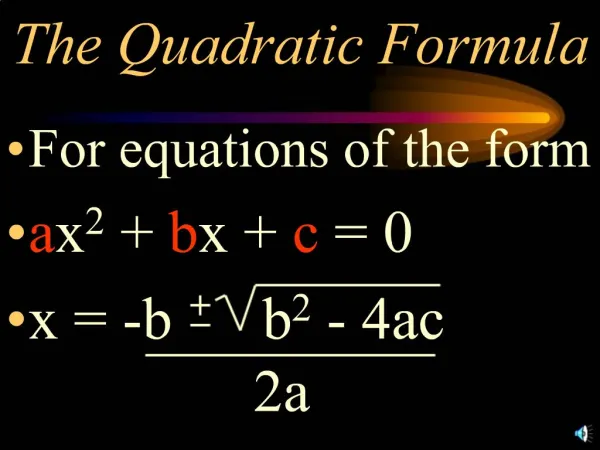
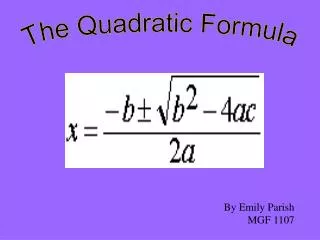
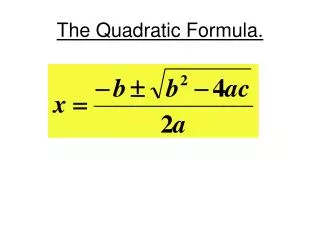
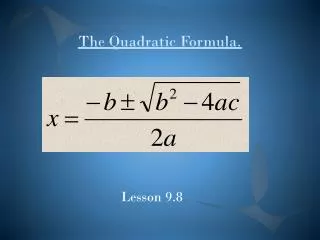
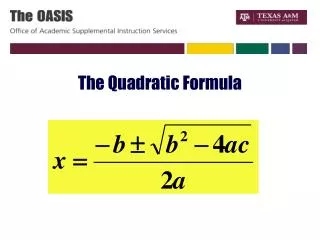
Dive into the essentials of the quadratic formula and the FOIL method to solve polynomial equations. This guide explains how to apply the FOIL technique (First, Outer, Inner, Last) to binomials, illustrated with examples such as (a + 3)(a + 2) and (b + 5)(b - 4). Additionally, learn to tackle quadratic equations of the form ax² + bx + c = 0, understanding how to find two numbers that add to b but multiply to c. Explore step-by-step solutions with practical applications that simplify algebraic problems effectively.


Understanding the Quadratic Formula and FOIL Method in Algebra
E N D
Presentation Transcript
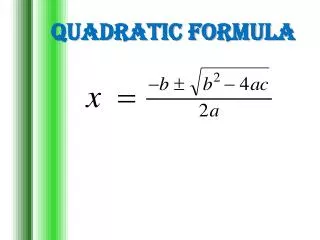
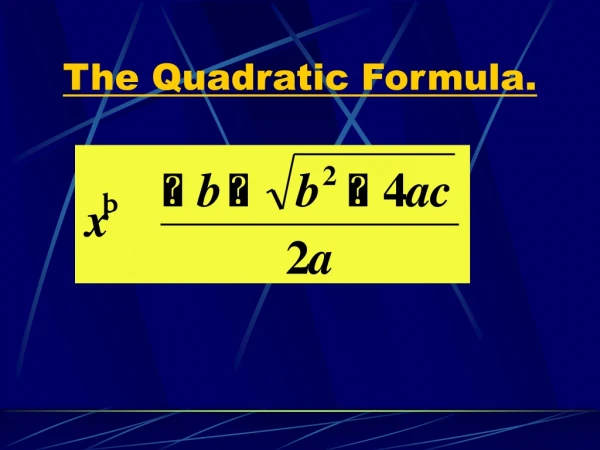
The Quadratic Formula and FOIL Algebra I
FOIL • F: First (a+3) (a+2) • O: Outer (a+3) (a+2) • I: Inner (a+3) (a+2) • L: Last (a+3) (a+2)
(a+3) (a+2)=0 (a x a) + (a x 2) + (a x 3) + (3 x 2) =0 a2 + 2a + 3a + 6 =0 a2+ 5a + 6 =0
(b+5) (b-4) =0 (b x b) – (b x 4) + (b x 5) – (4 x 5) =0 b2 – 4b +5b – 20 =0 b2 + b – 20 =0
General Equation ax2 + bx +c =0
x2 + 14x +49 =0 Goal: To find two numbers when added together give you b, but when multiplied give you c In this equation: a= 1 b= 14 c= 49
x2 + 14x +49 =0 ( _ _ _) ( _ _ _) =0 ( x + _) (x + _) =0 ( x +7) ( x + 7) =0 x + 7 =0 x +7 =0 x = -7 x = -7
4x2+2x -12 =0 ( _ _ _ ) ( _ _ _ ) =0 (2x + _) (2x - _) =0 Multiples of 12: 3 x 4, 2 x 6, 1 x 12 ( 2x+ 3) (2x – 4) =0 4x2 -2x -12 =0 (2x + 4) (2x – 3) =0 4x2 +2x -12 =0