Download
1 / 9
90 likes | 196 Vues
Muscles are vital organs enabling movement by contracting and relaxing. Over 600 muscles exist in the human body, with the smallest found in the ears and the largest in the thighs. They work in pairs, depending on energy from glucose for movement. Muscles are categorized into three types: skeletal (voluntary and striated), smooth (involuntary and non-striated), and cardiac (involuntary and striated). Proper muscle care involves regular exercise, warm-up stretches, and a balanced diet rich in protein to support growth and flexibility.

E N D
Muscles Chapter 18-2
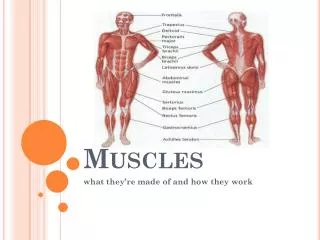
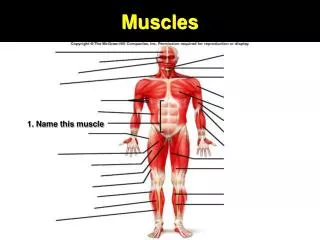
What is a muscle? • An organ that can relax and contract to allow movement • Attach to bones by tendons • More than 600 in our bodies • Smallest in our ears (stapedius) • Largest in our thighs (sartorious)
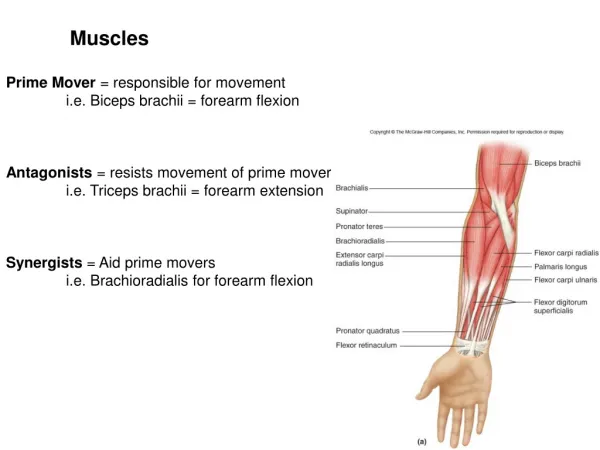
How do muscles work? • Works with your skeletal system. • Work by contracting or shortening. • Work in pairs- one muscle contracts, the other relaxes • Get the energy needed for movement from glucose.
Voluntary vs. Involuntary • Voluntary muscles: you can control • Ex: arms, legs • Involuntary muscles: you do not consciously control • Ex: heart, lungs, digestive tract
Types of Muscle • Skeletal- voluntary; striated; attached to bones to help us move. • Smooth- involuntary; non-striated; make up internal organs • Cardiac- involuntary; striated; found only in the heart to help it beat.
Taking care of your muscles • Exercise-helps cells grow in size • Warm up/stretch-increases blood flow to help muscle be more flexible • Well balanced diet (especially protein)