Understanding Acids, Bases, and the pH Scale: A Comprehensive Guide
This guide explores the essential concepts of acids and bases, focusing on the structure and functionality of the pH scale. It defines acids as substances releasing hydrogen ions (H+) and bases as those generating hydroxide ions (OH-). The pH scale ranges from 0 to 14, with acids having a pH less than 7 and bases exceeding 7. We delve into common household substances' acidity or basicity, the characteristics of acids and bases, and the process of neutralization, illustrated by examples like HCl and NaOH reactions. Also covered are pH testing techniques using litmus paper.

Understanding Acids, Bases, and the pH Scale: A Comprehensive Guide
E N D
Presentation Transcript
1 Acids & Bases
2 Acids and Bases Goals A. Explain the structure of the pH scale. B. Compare and contrast the components and properties of acids and bases. C. Determine whether common household substances are acidic, basic, or neutral.
3 The pH Scale • pH comes from the Greek word potenzmeaning power (and H for hydrogen). • Measurement system that indicates the number of H+ ions in solution.
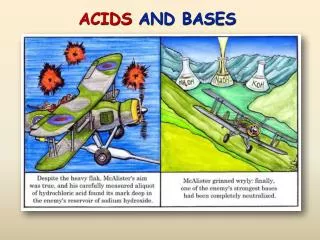
Acids are molecules that release hydrogen ions in solution. 4 Bases are molecules that either take up hydrogen ions or give off hydroxide ions in solution. HCl H+ + Cl- NaOH Na+ + OH-
5 Characteristics of Acids • pH less than 7 • Produces hydrogen ions (H+) in solution. • When added to water H+ interacts with the H2O to produce H30 +(Hydronium ion) • Taste sour • Corrosive • Look at page 767. • What do all of the acids have in common?
6 Characteristics of Bases • pH higher than 7 • Produces hydroxide ions (OH-) in solution • Bitter taste • Strong bases can be corrosive. • Look at page 769. • What do all of the bases have in common?
7 Strength of Acids & Bases Bases Strong: Ionize Completely in Solutions. Acids Strong: Ionize Completely in Solutions.
8 Neutralization ACID + Base ==>SALT + WATER HCl(aq) + NaOH(aq)==> NaCl(aq) + H2O(l) • H+ ions react with the OH- to produce water. • A salts forms from the negative ion in the acid and the positive ion in the base. ACID + ALKALI ==> SALT + WATER HCl(aq) + Ca(OH)2(aq)==> CaCl2(aq) + H2O(l)
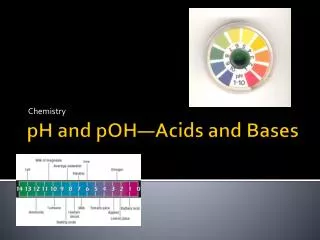
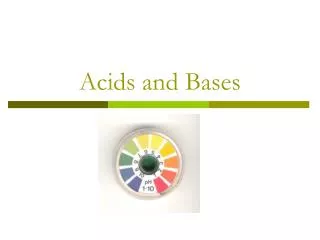
9 Litmus Paper / pH paper Testing pH
10 Litmus paper contains a substance that changes color in either an acid or a base.
11 Red Litmus Paper If red turns blue, it is a BASE!
12 Blue Litmus Paper If blue turns red, it is an ACID!
13 Litmus Paper
14 Acids & Bases Video