Acids and bases
Acids and bases play crucial roles in our everyday lives. Acids, which have a sour taste, include substances like vinegar (ethanoic acid) and lemon juice (citric acid). Chemists classify these based on their ability to release hydrogen ions into solutions. Conversely, bases release hydroxide ions and are often found in strong household cleaners. The pH scale helps us determine the acidity or alkalinity of a solution, ranging from pH 0 (strongly acidic) to pH 14 (strongly alkaline) with neutral solutions at pH 7. Understanding these concepts is vital in both chemistry and daily applications.

Acids and bases
E N D
Presentation Transcript
Acids & bases • Why do vinegar or lemon juice taste sour? • They are Acids! • The term acid comes from the Latin term acere, which means “sour” • In the 17th century, chemist Robert Boyle first labeled substances as acids or bases according to certain characteristics. • 1st reasonable definition for acids and bases was not proposed until the 19th century, with Swedish scientist Svante Arrhenius
arrhenius • Stated that Acids contained Hydrogen and release hydrogens into solution • Bases release OH- (Hydroxide Ions) into solution. • Acids and Bases can combine to neutralize, or counteract each other.
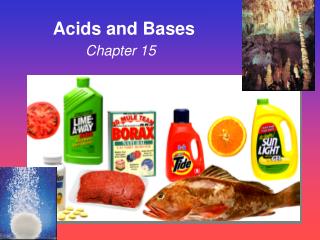
Acids • Acids in the home • Dilute weak acids • Have a sour taste • Safe to use in food, but can still hurt if they get into a cut or eyes • Examples • Vinegar = Ethanoic Acid • Fizzy Drinks (Soda) = Carbonic Acid • Tea = Tannic Acid • Vitamin C = Ascorbic Acid • Lemons = Citric Acid
Bases • React with oils and fats • Often used in strong household cleaners • Examples • Drain cleaners and oven cleaners contain Sodium Hydroxide • Ammonia is also used in cleaners • Wise to wear gloves with these substances because it will burn skin! • Weak bases are found in toothpaste, antacid tablets (help to cure an upset stomach) and baking powder
Indicators and the ph scale • Indicator: substance that can change color when they are added to acidic or alkaline/basic solutions • You can prepare your own homemade indicators • Two commonly used indicators • Litmus paper • Universal indicator
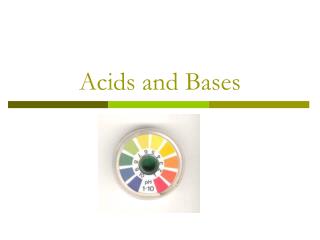
Universal indicator • Is a mixture of several different indicators • It shows us EXACTLY how strongly acidic or alkaline/basic a solution is • Measured using the PH Scale, which runs from 0 to 14 • Has many different colors, from red for strong acids to dark purple for strong bases. In the middle, neutral pH 7 is indicated by green.
PH Scale • Neutral solutions have a pH of 7 • Acidic solutions have a pH less than 7 • Basic solutions have pH values more than 7 • The closer to pH 0 you go, the more strongly acidic • The closer to pH 14 you go, the more strongly alkaline/basic