Enhancing Requirements Management in Complex Projects: Best Practices and Considerations
Managing requirements in complex projects presents numerous challenges, such as reliance on knowledgeable personnel, high staff turnover, and the involvement of multiple stakeholders. With requirements often exceeding 10,000, ensuring they are clearly understood, implemented in design, and tied back to stakeholders is crucial. This document outlines best practices for requirements management, emphasizing its significance as an enterprise process. Important considerations include the need for clear roles, traceability, compliance verification, and the integration of changes. Learning from industry standards (ISO 29148, ISO 15288) can enhance outcomes and prevent unforeseen delays and costs.

Enhancing Requirements Management in Complex Projects: Best Practices and Considerations
E N D
Presentation Transcript
Requirements Management Program Functions R-9 Michael deLamare
Need for Requirements Management • Reliance on the intelligent informed individual (People over Process) • Staff Turnover and long projects • Many requirements from multiple stakeholders that staff are expected to know • Contract, Laws, regulations, interfacing facilities, etc. • Easily exceed 10,000 • Requirements are not implemented in design • They do not systematically flow down to design or to suppliers. • Requirements changes are not well understood prior to approval • Leads to unanticipated schedule delays and unexpected cost growth. • Requirements are incomplete, unclear and subject to widely varying interpretations. • Unable to justify requirements readily • Difficulty verifying requirements were met.
Important Considerations for Establishing a Program • Learn from Industry • ISO 29148, ISO 15288, etc. • Recognize that RM is an enterprise process • not just bookkeeping • Must be intertwined with system development processes • Key Systems Engineering concepts are needed • Clear roles, responsibilities accountabilities & authorities • Process over tools
Arriving at Recommendations Best Practices Recommendations Voice of the Customer Project Process Design Project Gaps and Issues Process Failure Modes
Key Concept: “V” Model Plant/Facility Requirements Plant/Facility Validation System/ Structure Requirements System/ Structure Verification Component Requirements Component Verification
Key Concept: Technical Requirement Areas These technical requirements areas need to be recognized when developing requirements
High Ranked Program Needs • Baseline Requirements • Responsible requirement owners • Interpretive authority • Requirements validation • Two-way traceability down to the appropriate level • Enable change impact analysis • Protect assumptions/requirements • Support Procurement • Support Verification
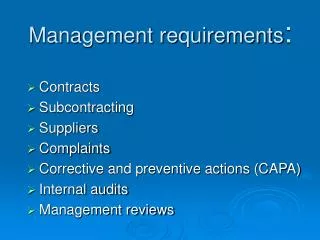
Requirements Management Process • RM Functions • Identify and Document • Analyze and Allocate • Control Change • Verify Compliance • Oversight Inputs Outputs • Contract • Client Specifications • Operational Concepts • Laws/Regs • Permits • Etc. • Managed RqmtsBaseline • Validated • Traceable • Verified Rqmts • Metrics These are a proposed set of RM Functions
Requirements Management Functions These Functions establish and maintain a Project Requirements Baseline • Identification and Documentation • Identify/Elicit Requirements • Document Requirements • Analysis and Allocation • Analyze Requirements • Validate Requirements • Allocate Requirements • Trace Requirements • Document Analysis and Allocation • Change Control • Control Change • Verification • Verify Compliance • Process Oversight • Organize Requirements • Balance and Integrate Requirements • Manage Process