Download

1 / 6
60 likes | 170 Vues
Explore the myths surrounding the origin, cultural significance, and evolution of the Olympic Games from ancient times to the modern era. Learn about the historical impact of the games on society, art, philosophy, and sportsmanship. Discover how the Olympics transformed into the international event we know today.

E N D
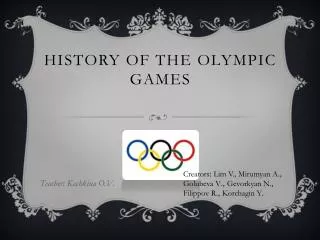
Тартарашвили Элене 9Б МБОУ СОШ №1 Учитель:Канищева Елена Анатольевна From History of the Olympic Games
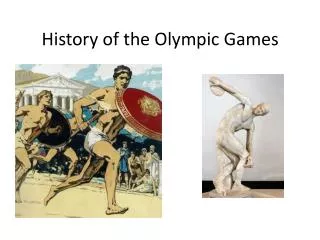
There are many myths about the origin of the Olympic Games. Honorable to their ancestors considered gods, mythical heroes, kings and rulers. It is well established that the first known Olympic Games took place in 776 BC. e. Every Olympics turned into a celebration for the people, served as a kind, the Congress for the rulers and philosophers, the competition for sculptors and poets, playwrights and singers. It is a time of universal truce between warring policies.
Sports and sporting events have already started in this ancient period. The winners of the competition were revered as heroes in the war. The first documented celebration refers to the year 776 BC. e. They were established by Heracles, although it is known that the games were held in the past. At the time of the game was declared a sacred truce (έκεχειρία), at that time it was impossible to wage war. Olympics essentially lost its meaning with the arrival of the Romans. After Christianity became the official religion, the game came to be seen as a manifestation of paganism, and in 394 BC. e. they were banned by Emperor Theodosius I.
Olympic Games - the largest international multi-sport event of our time, which are held every four years. Tradition, which existed in ancient Greece, at the end of XIX century, was revived by a French philanthropist Pierre de Coubertin. Baron Pierre de Coubertin
First modern Olympic Games were held In Greece, in 1896. First modern Olympic Games were held In Greece, in 1896.