Position Sensing Technologies: Mechanical, Optical, and Magnetic Solutions
Explore the various position sensing technologies used in automation and robotics, including mechanical, optical, and magnetic solutions. Learn about microswitches, their hysteresis and actuators, as well as advancements in optical sensing with LEDs and photodiodes, featuring modulated and unmodulated light systems. Discover magnetic sensors such as Hall sensors and reed switches, as well as inductive proximity sensors. We will also discuss discrete position sensors like capacitive and ultrasonic types, alongside advanced encoder technologies, including incremental and absolute encoders, and magnetostrictive position sensors.

Position Sensing Technologies: Mechanical, Optical, and Magnetic Solutions
E N D
Presentation Transcript
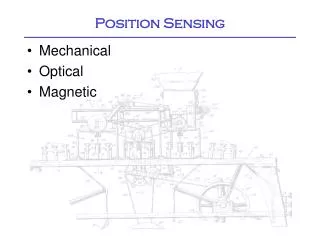
Position Sensing • Mechanical • Optical • Magnetic
Microswitch Operation Switch exhibits mechanical hysteresis.
Optical Sensing • LED’s and Photodiodes • Transmissive/Reflective • Modulated/Unmodulated • Light-on/Dark-on • Fiber optic
Modulation • “Chop” LED on and off at many kHz rate • Bandpass filter after photodiode at the same frequency as chopping • Threshold circuit after BPF generates on/off output
Magnetic Position Sensors • Reed switches (sense permanent magnet) • Inductive proximity sensors (eddy current) • Hall Sensors (sense permanent magnet)
Hall Sensors • Hall effect: • constant voltage forces a constant current in semiconductor sheet • magnetic field flux lines perpendicular to current cause proportional voltage across sheet. • discovered by E.F.Hall in 1879 • Linear sensor needs voltage regulator and amplifier • Switch also needs threshold circuit, with hysteresis
Hall Switch • Magnet motion • head-on • bypass or slide-by • Total effective air gap (TEAG) • Sensitivity, Hysteresis, & Temperature
Other Discrete Position Sensors • capacitive • ultrasonic • variable reluctance (coil around magnet, senses moving ferrous material)
Incremental Encoders • Encoders typically run on +5V, not +24V • Outputs are typ. not 24V compatible either
Absolute Encoders • doubling resolution requires adding another photodiode/LED pair • cost is much higher than incremental • does not require seeking to establish reference location
Potentiometer • A potentiometer (or pot) is a variable resistor wired to obtain a variable DC voltage proportional to position
Magnetostrictive Pos. Sensor • Pulse sent down magnetostrictive material • Pulse reflects off position magnet’s field • Position is proportional to trcvd - tsent • Pulse propagates at ~2800 m/s • Resolution is ~.001” with tupdate ~1msec/in.