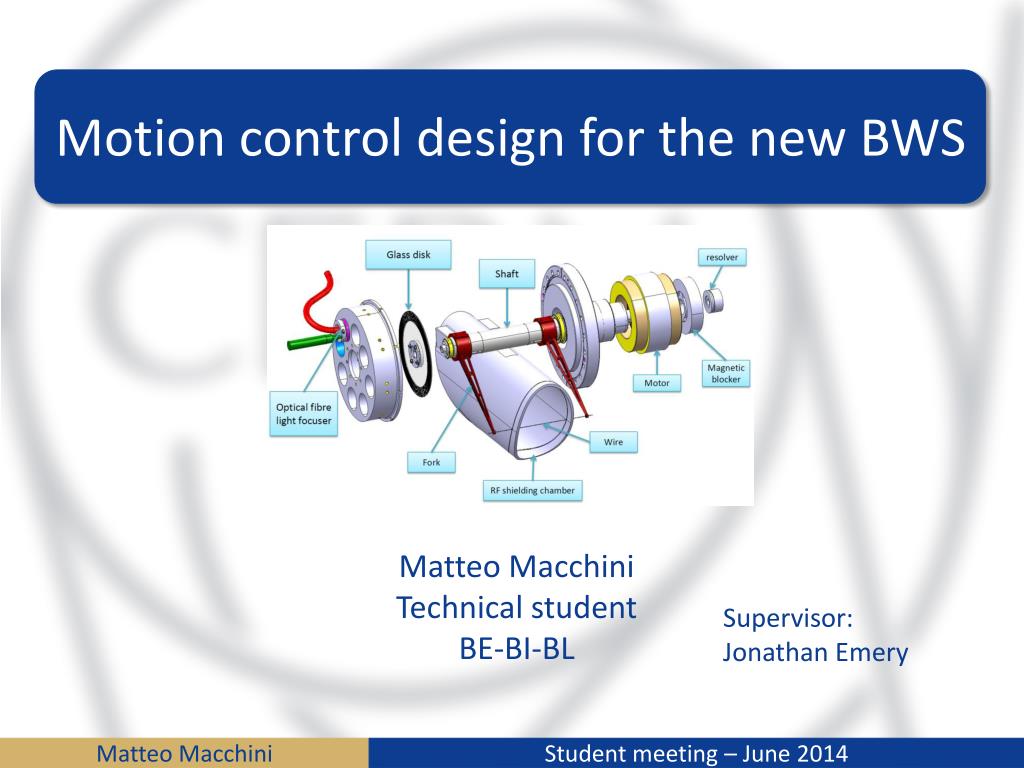
Motion control design for the new BWS Matteo Macchini Technical student BE-BI-BL Supervisor:Jonathan Emery Matteo Macchini Student meeting – June 2014
Outline • PSO method overview • Detailed description of the system • SVPWM implementation and testing • Tuning results from the simulations • Robust stability/performance analysis • Conclusions – what’s next? Matteo Macchini Student meeting – June 2014
Particle Swarm Optimization • How does it work? • Given a multi-dimensional function: • Initialises random particles • (parameter values) • Computes cost • Updates position and speed of • the particles making them move • towards the best result obtained • so far Matteo Macchini Student meeting – June 2014
Particle Swarm Optimization Iteration 1 Matteo Macchini Student meeting – June 2014
Particle Swarm Optimization Iteration 10 Matteo Macchini Student meeting – June 2014
Particle Swarm Optimization Iteration 20 Matteo Macchini Student meeting – June 2014
Particle Swarm Optimization Iteration 30 Matteo Macchini Student meeting – June 2014
Particle Swarm Optimization Cost function Matteo Macchini Student meeting – June 2014
Previously achieved results Current loop Iteration 1 Iteration 7 Iteration 4 Iteration 10 Speed loop Iteration 1 Iteration 7 Iteration 4 Iteration 10 Matteo Macchini Student meeting – June 2014
“Old” model Current sensor IGBT inverter Cable Motor Analog filter Control system PWM Matteo Macchini Student meeting – June 2014
Simplified model(s) Cascade version Control system Current sensor Cable Amplifier Motor Control analysis • Main differences from classic version • Ideal amplifier (no PWM-inverter-filter blocks) • Fully digital implementation and simulation (no Simulink-simscape switch) • Typical cascade control system with no AW feature • Control analysis for iterative optimization Matteo Macchini Student meeting – June 2014
Simplified model(s) Parallel version Control system Current sensor Cable Amplifier Motor Control analysis • Differences from cascade version • Parallel control system with no AW feature • (designed entirely from scratch) Matteo Macchini Student meeting – June 2014
Space Vector PWM Principle: Differently from classic SPWM, SVPWM transforms a three-phase sinusoidal wave into its PWM, considering the combination of the three inputs at once. • Advantages [1] : • Lower THD (Total Harmonic Distortion) • Greater PF (Power Factor) • Less switching losses • Lower computational cost Matteo Macchini Student meeting – June 2014
Space Vector PWM implementation Simulinkimplementation SVPWM block Low-pass filters Obtained waveform Output coherent with expectations Couldn’t appreciate advantages (SO FAR!) Matteo Macchini Student meeting – June 2014
Tuning strategy • Create system model • Initialize parameters • Implement system control based • on desired dynamics • Compute a COST FUNCTION • based on the obtained results • Modify parameters in order to • minimize the CF Matteo Macchini Student meeting – June 2014
Cost function computation As a cost function, the integral absolute error (IAE) between the desired motion profile and the results has been used. To improve its quality, some weights were added on the critical zones of the dynamic. Matteo Macchini Student meeting – June 2014
Simulations and results Cascade design, 100 particles, 10 iterations Matteo Macchini Student meeting – June 2014
Simulations and results Cascade design, 100 particles, 10 iterations Matteo Macchini Student meeting – June 2014
Simulations and results Parallel design, 100 particles, 10 iterations Matteo Macchini Student meeting – June 2014
Simulations and results Parallel design, 100 particles, 10 iterations Matteo Macchini Student meeting – June 2014
Simulations and results Cost function evolution Matteo Macchini Student meeting – June 2014
Cable modeling • For the last simulations, a cable model has been implemented. • It takes into account: • Cable self attenuation • Cable cross-talk • Cable length Matteo Macchini Student meeting – June 2014
Performance/robustness PERFORMING controller: the reference profile is followed “properly”, i.e. the cost function has a “low” value. ROBUST controller: results are “similar” into a given range of uncertainty. A controller should be performing in order to guarantee the control quality for the tested device. A controller should be robust in order to guarantee the control quality for a family of devices working in different technical/environmental conditions. Matteo Macchini Student meeting – June 2014
Robustness test Robust controller: results are “similar” into a given range of uncertainty (cable length variable between 1m and 300m) Robust controller Non-robust controller Matteo Macchini Student meeting – June 2014
Robustness test Robust controller: results are “similar” into a given range of uncertainty (cable length variable between 1m and 300m) Robust controller Non-robust controller Matteo Macchini Student meeting – June 2014
Robustness test Robust controller: results are “similar” into a given range of uncertainty (cable length variable between 1m and 300m) Robust controller Non-robust controller Matteo Macchini Student meeting – June 2014
Robust synthesis • IDEA: • Launch tuning algorithm several times • Test robustness • Check if robust controller have • similar parameters and try to • reproduce them Non-robust controller Matteo Macchini Student meeting – June 2014
Conclusions • Particle Swarm Optimization can be used to tune controller parameters in the considered system • SVPWM will help increasing the quality of the amplifier • Cascade architecture: good performances, very good robustness • Parallel architecture: very good performance, hard to make robust • Robust controllers can be tuned using iterative methods Matteo Macchini Student meeting – June 2014
In the future… • NEXT GOALS • Validating the previous system • Implement control on the bench • Make it work properly • Study VHDL/hardware design in order to port it on FPGA Matteo Macchini Student meeting - May 2014
References [1] Waheed Ahmed, Syed M Usman Ali, “Comparative study of SVPWM & SPWM three phase voltage source inverters for variable speed drive” Matteo Macchini Student meeting – June 2014