
Objective/Warm-Up
This lesson guides students in predicting the strength of acids based on atomic bonding. Through the comparison of various oxoacids, students learn that HClO3 is the strongest among them due to its electronegative central atom and the presence of multiple oxygen atoms that stabilize the anion. The session highlights the distinctions between acidic and basic oxides, illustrating strong covalent bonds in acidic oxides (like SO2 and NO2) versus ionic bonds in basic oxides (such as K2O and CaO). Students will also explore the relationship between acid strength and molecular structure.

Objective/Warm-Up
E N D
Presentation Transcript
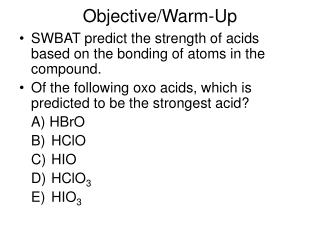
Objective/Warm-Up • SWBAT predict the strength of acids based on the bonding of atoms in the compound. • Of the following oxo acids, which is predicted to be the strongest acid? A) HBrO B) HClO C) HIO D) HClO3 E) HIO3
Answer is “D” Among HBrO, HClO, and HIO, the more electronegative central atom indicates a stronger oxo acid. Therefore HClO is the strongest of these three. For the same reason, we choose HClO3 over HIO3 as the strongest acid in this pair. Comparing HClO and HClO3, we select HClO3 as the strongest because it has the larger number of unshared or double-bonded oxygen atoms that stabilize the anion, creating a stronger acid.
Oxides • Acidic Oxides (Acid Anhydrides): • OX bond is strong and covalent. • SO2, NO2, CrO3 • Basic Oxides (Basic Anhydrides): • OX bond is ionic. • K2O, CaO
Figure 14.4Graphic Representation of the Behavior of Acids of Different Strengths in Aqueous Solution
Figure 14.11The Effect of the Number of Attached Oxygens on the O-H Bond in a Series of of Chlorine Oxyacids