Mastering Systems of Linear Equations and Inequalities
330 likes | 433 Vues
This comprehensive guide covers methods for solving systems of linear equations through graphing, substitution, and elimination. It also explores applications of linear systems and provides insights into linear inequalities, including graphing techniques and interpretation. Each lesson is designed to build understanding, from the basics of plotting equations to handling more complex scenarios. With practice problems and reviews, this resource equips students with the necessary tools to solve linear equations in various contexts.


Mastering Systems of Linear Equations and Inequalities
E N D
Presentation Transcript
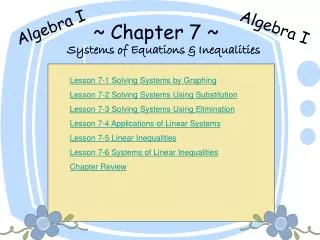
Algebra I Algebra I ~ Chapter 7 ~ Lesson 7-1 Solving Systems by Graphing Lesson 7-2 Solving Systems Using Substitution Lesson 7-3 Solving Systems Using Elimination Lesson 7-4 Applications of Linear Systems Lesson 7-5 Linear Inequalities Lesson 7-6 Systems of Linear Inequalities Chapter Review Systems of Equations & Inequalities
Lesson 7-1 Solving Systems by Graphing Cumulative Review Chap 1-6
Lesson 7-1 Solving Systems by Graphing Cumulative Review Chap 1-10
Lesson 7-1 Solving Systems by Graphing System of linear equations – Two or more linear equations together… One way to solve a system of linear equations is by… Graphing. Solving a System of Equations Step 1: Graph both equations on the same plane. (Hint: Use the slope and the y-intercept or x- & y-intercepts to graph.) Step 2: Find the point of intersection Step 3: Check to see if the point of intersection makes both equations true. Solve by graphing. Check your solution. y = x + 5 y = -4x Your turn… y = -1/2 x + 2 y = -3x - 3 Notes ~ Try another one ~ x + y = 4 x = -1
Lesson 7-1 Solving Systems by Graphing Systems with No Solution When two lines are parallel, there are no points of intersection; therefore, the system has NO SOLUTION! y = -2x + 1 y = -2x – 1 Systems with Infinitely Many Solutions y = 1/5x + 9 5y = x + 45 Since they are graphs of the same line… There are an infinite number of solutions. Notes
Lesson 7-1 Solving Systems by Graphing Homework – Practice 7-1 #1-28 odd Homework
Lesson 7-2 Solving Systems by Substitution Practice 7-1
Lesson 7-2 Solving Systems Using Substitution Using Substitution Step 1: Start with one equation. Step 2: Substitute for y using the other equation. Step 3: Solve the equation for x. Step 4: Substitute solution for x and solve for y Step 5: Your x & y values make the intersection point (x, y). Step 6: Check your solution. y = 2x 7x – y = 15 Your turn… y = 4x – 8 y = 2x + 10 Notes ~ Another example~ c = 3d – 27 4d + 10c = 120
Lesson 7-2 Solving Systems Using Substitution Using Substitution & the Distributive Property 3y + 2x = 4 -6x + y = -7 Step 1: Solve the equation in which y has a coefficient of 1… -6x + y = -7 +6x +6x y = 6x -7 Step 2: Use the other equation (substitute using the equation from Step 1.) 3y + 2x = 4 3(6x – 7) + 2x = 4 18x – 21 + 2x = 4 20x = 25 x = 1 1/4 Notes Step 3: Solve for the other variable Substitute 1 ¼ or 1.25 for x y = 6(1.25) – 7 y = 7.5 -7 y = 0.5 Solution is (1.25, 0.5)
Lesson 7-2 Solving Systems Using Substitution Your turn… 6y + 8x = 28 3 = 2x – y Solution is (2.3, 1.6) or (2 3/10, 1 3/5) A rectangle is 4 times longer than it is wide. The perimeter of the rectangle is 30 cm. Find the dimensions of the rectangle. Let w = width Let l = length l = 4w 2l + 2w = 30 Solve for l… l = 4(3) l = 12 Use substitution to solve. 2(4w) + 2w = 30 8w + 2w = 30 10w = 30 w = 3 Notes
Lesson 7-2 Solving Systems Using Substitution Homework ~ Practice 7-2 even Homework
Lesson 7-3 Solving Systems Using Elimination Practice 7-2
Lesson 7-3 Solving Systems Using Elimination Adding Equations Step 1: Eliminate the variable which has a coefficient sum of 0 and solve. Step 2: Solve for the eliminated variable. Step 3: Check the solution. 5x – 6y = -32 3x + 6y = 48 8x + 0 = 16 x = 2 Solution is (2, 7) Check 3(2) + 6(7) = 48 6 + 42 = 48 48 = 48 Your turn… 6x – 3y = 3 & -6x + 5y = 3 5x – 6y = - 32 5(2) – 6y = - 32 10 – 6y = -32 -6y = -42 y = 7 Notes
Lesson 7-3 Solving Systems Using Elimination Multiplying One Equation Step 1: Eliminate one variable. -2x + 15y = -32 7x – 5y = 17 Step 2: Multiply one equation by a number that will eliminate a variable. -2x + 15y = -32 3(7x – 5y = 17) Step 3: Solve for the variable 19x = 19 x = 1 Step 4: Solve for the eliminated variable using either original equation. -2(1) + 15y = -32 Solution (1, -2) • -2x + 15y = -32 • 21x - 15y = 51 19x + 0 = 19 Notes -2 + 15y = -32 15y = -30 y = -2
Lesson 7-3 Solving Systems Using Elimination Your turn… 3x – 10y = -25 4x + 40y = 20 Solution (-5, 1) Multiply Both Equations Step 1: Eliminate one variable. 4x + 2y = 14 7x – 3y = -8 Step 2: Solve for the variable 26x = 26 x = 1 Try this one… 15x + 3y = 9 10x + 7y = -4 • 3(4x + 2y = 14) • 2(7x – 3y = -8) • 12x + 6y = 42 • 14x – 6y = -16 26x + 0 = 26 Notes Step 3: Solve for the eliminated variable 4(1) + 2y = 14 2y = 10 y = 5 Solution (1, 5)
Lesson 7-3 Solving Systems Using Elimination Homework – Practice 7-3 odd Homework
Lesson 7-4 Applications of Linear Systems Practice 7-3
Lesson 7-4 Applications of Linear Systems Notes
Lesson 7-4 Applications of Linear Systems Homework – Practice 7-4 #6-10 Homework
Lesson 7-5 Linear Inequalities Practice 7-4
Lesson 7-5 Linear Inequalities • Using inequalities to describe regions of a coordinate plane: • x < 1 • y > x + 1 • y ≤ - 2x + 4 • Steps for graphing inequalities… • (1) First graph the boundary line. • (2) Determine if the boundary line is a dashed or solid line. • Shade above or below the boundary line… (< below or > above) • Graph y ≥ 3x - 1 • Rewriting to Graph an Inequality • Graph 3x – 5y ≤ 10 • Solve for y… (remember if you divide by a negative, the inequality sign changes direction) then apply the steps for graphing an inequality. • Graph 6x + 8y ≥ 12 Notes
Lesson 7-5 Linear Inequalities Homework ~ Practice 7-5 odd Homework
Lesson 7-6 Systems of Linear Inequalities Practice 7-5
Lesson 7-6 Systems of Linear Inequalities Practice 7-5
Lesson 7-6 Systems of Linear Inequalities Practice 7-5
Lesson 7-6 Systems of Linear Inequalities • Solve by graphing… • x ≥ 3 & y < -2 • You can describe each quadrant using inequalities… • Quadrant I? • Quadrant II? • Quadrant III? • Quadrant IV? • Graph a system of Inequalities… • (1) Solve each equation for y… • (2) Graph one inequality and shade. • (3) Graph the second inequality and shade. • The solutions of the system are where the shading overlaps. • Choose a point in the overlapping region and check in each inequality. Notes
Lesson 7-6 Systems of Linear Inequalities Graph to find the solution… y ≥ -x + 2 & 2x + 4y < 4 Writing a System of Inequalities from a Graph Determine the boundary line for the pink region… y = x – 2 The region shaded is above the dashed line… so y > x – 2 Determine the boundary line for the blue region… y = -1/3x + 3 The region shaded is below the solid line… so y ≤ -1/3x + 3 Your turn… Notes
Lesson 7-6 Systems of Linear Inequalities Homework 7-6 odd Practice 7-6
Lesson 7-6 Systems of Linear Inequalities Practice 7-6
Lesson 7-6 Systems of Linear Inequalities Practice 7-5
Lesson 7-6 Systems of Linear Inequalities Practice 7-6
Algebra I Algebra I ~ Chapter 7 ~ Chapter Review
Algebra I Algebra I ~ Chapter 7 ~ Chapter Review