Physics at LHC
450 likes | 565 Vues
This presentation by Fabiola Gianotti (CERN) discusses the Large Hadron Collider (LHC) project. It explains the LHC's purpose in searching for new massive particles and conducting precision measurements of fundamental particles, including the Higgs boson. The talk highlights the experimental challenges faced by the ATLAS and CMS collaborations, both dedicated to exploring the interactions that govern particle physics. The need for a high-energy collider like the LHC arises from unanswered questions within the Standard Model and seeks to uncover phenomena beyond its current understanding.


Physics at LHC
E N D
Presentation Transcript
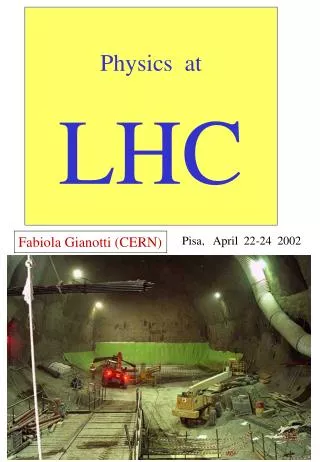
Physics at LHC Fabiola Gianotti (CERN) Pisa, April 22-24 2002
At LEP, Tevatron and LHC Outline • Part 1 : Introduction What is the LHC ? Why the LHC ? Experimental challenges The ATLAS and CMS experiments Overview of the physics programme • Part 2 : Precise measurements and Higgs searches Measurements of the W and top masses Higgs searches • Part 3 : Physics beyond the Standard Model Motivations Searches for SUSY Searches for Extra-dimensions
LHC • pp machine (mainly): = 14 TeV 7 times higher than present highestenergy machine (Tevatron/Fermilab: 2 TeV) search for new massive particles up to m ~ 5 TeV = 1034 cm-2 s-1 ~ 102larger than LEP2, Tevatron searchfor rare processes with small s (N = Ls) • under construction, ready 2007 • will be installed in the existing LEP tunnel • two phases: • 2007 - 2009 :L ~ 1033 cm-2 s-1 , Ldt 10 fb-1 (1 year) • “low luminosity” • 2009 - 20xx :L ~ 1034 cm-2 s-1 , Ldt 100 fb-1 (1 year) • “high luminosity”
Four large-scale experiments: ATLAS CMS general-purpose pp experiments LHCbpp experiment dedicated to b-quark physics and CP- violation.L=1032 cm-2 s-1 ALICE heavy-ion experiment(Pb-Pb collisions) at 5.5 TeV/nucleon s 1000 TeV Quark-gluon plasma studies. L=1027 cm-2 s-1 Here : ATLAS and CMS
Limiting factor for s : bending power needed to fit ring in 27 km circumference LEP tunnel: p (TeV) = 0.3 B(T) R(km) = 7 TeV = 4.3 km LHC : B=8.4 T : ~ 1300 superconducting dipoles working at 1.9 K (biggest cryogenic system in the world) A few machine parameters
LHC is unprecedented machine in terms of: • Energy • Luminosity • Cost : 4000 MCHF(machine + experiments) • Size/complexity of experiments: • ~ 1.3-2 times bigger than present collider experiments • ~ 10 times more complex • Human resources : > 4000 physicists in the • experiments WHY?
Motivation 1 : Origin of particle masses Standard Model of electroweak interactions verified with precision 10-3 - 10-4 by LEP measurements at s mZ and Tevatron at s = 1.8 TeV. discovery of top quark in ‘94, mtop 174 GeV However: origin of particle masses not known. Ex. : mg = 0 mW, Z 100 GeV Motivations for LHC
f H ~ mf SM : Higgs mechanism gives mass to particles (Electroweak Symmetry Breaking) mH < 1 TeV from theory For mH ~ 1 TeV GH > mH and WW scattering violates unitarity However: -- Higgs not found yet: only missing (but essential) piece of SM -- present limit : mH > 114.1 GeV (from LEP) -- “hint” at LEP for mH 115 GeV -- Tevatron may go beyond (depending on L) need a machine to discover/exclude Higgs from 120 GeV to 1 TeV LHC
H H E (GeV) • Motivation 2 : Is SM the “ultimate theory” ? • Higgs mechanism is weakest part of the SM: • -- “ad hoc” mechanism, little physical justification • -- due to radiative corrections • DmH2 ~ L2 L : energy scale • up to which SM • is valid (can be very large). • radiative corrections can be very large (“unnatural”) • and Higgs mass can diverge unless “fine-tuned” • cancellations “ bad behaviour ” of the theory • Hints that forces could unify at E ~ 1016 GeV a1=aEM1/128 a2=aWEAK 0.03 a2=aS 0.12 s ~ 100 GeV Running of couplings proven experimentally GUT: for E > 1016 GeV physics become simple (one force with strength aG)
SM is probably low-energy approximation of • a more general theory • Need a high-energy machine to look for • manifestations of this theory • e.g. Supersymmetry :mSUSY ~ TeV • Many other theories predict New Physics at • the TeV scale LHC
Motivation 3 : Many other open questions • Are quarks and leptons really elementary ? • Why 3 fermion families ? • Are there additional families of (heavy) quarks and • leptons ? • Are there additional gauge bosons ? • What is the origin of matter-antimatter asymmetry in the • universe ? • Can quarks and gluons be deconfined in a quark-gluon • plasma as in early stage of universe ? • …. etc. …... • Motivation 4 : The most fascinating one … • Unexpected physics ? • Motivation 5:Precise measurements • Two ways to find new physics: • -- discover newparticles/phenomena • -- measure properties of known particles • as precisely as possible find deviations • from SM
LHC: known particles (W, Z, b, top, …) produced with enormous rates thanks to high energy (high s) and L ( high rate) Ex.:5 X 10⁸W 5 X 10⁷Z per year at low L 107pairs 1012pairs many precision measurements possible thanks to large statistics (stat. error ~ 1/ N) error dominated by systematics Note : measurements of Z parameters performed at LEP and SLD, however precision can be improved for : -- W physics -- Triple Gauge Couplings WWg, WWZ -- b-quark physics -- top-quark physics
p pT n. events Rate = second 1034 cm-2 s-1 Phenomenology of pp collisions Transverse momentum (in the plane perpendicular to the beam) : pT = p sin Rapidity: = 90o = 0 = 10o 2.4 = 170o -2.4 Total inelastic cross-section: stot(pp) = 70 mbs = 14 TeV = Lx stot (pp) = 109 interactions/s These include two classes of interactions.
Class 1: Most interactions due to collisions at large distance between incoming protons where protons interact as “ a whole ” small momentum transfer (Dp /Dx ) particles in final state have large longitudinal momentum but small transverse momentum (scattering at large angle is small) <pT>500 MeVof charged particles in final state chargedparticles uniformly distributed in Most energy escapes down the beam pipe. These are calledminimum-bias events(“ soft “ events). They are the large majority but are not very interesting.
x1p x2p u W+ Class 2: Monochromatic proton beam can be seen as beam of quarks and gluons with a wide band of energy. Occasionally hard scattering (“ head on”) between constituents of incoming protons occurs. p momentum of incoming protons = 7 TeV Interactions at small distance large momentum transfer massive particles and/or particles at large angle are produced. These are interesting physics events but they arerare. Ex. u + W+ s (pp W) 150 nb 10-6stot (pp)
effective centre-of-mass energy smaller • than s of colliding beams: pA= pB= 7 TeV if xa xb to produce m 100 GeV x ~ 0.01 to produce m 5 TeV x ~ 0.35 Unlike at e+e- colliders
hard scattering cross-section fi (x, Q2) parton distribution function • cross-section : p uud
25 ns detector Two main difficulties • Typical of LHC: • R = Ls = 109interactions / second • Protons are grouped in bunches (of 1011 protons) • colliding at interaction points every 25 ns At each interactionon average 25 minimum-bias events are produced. These overlap with interesting (high pT) physics events, giving rise to so-called pile-up ~1000 charged particles produced over || < 2.5 at each crossing. However < pT > 500 MeV(particles from minimum-bias). applyingpT cut allows extraction of interesting particles
H ZZ 4m Simulation of CMS inner detector
Pile-up is one of the most serious experimental difficulty at LHC • Large impact on detector design: • LHC detectors must have fast response, otherwise • integrate over many bunch crossings too large pile-up • Typical response time : 20-50 ns • integrate over 1-2 bunch crossings pile-up of • 25-50 minimum bias • very challenging readout electronics • LHC detectors must be highly granular to minimise • probability that pile-up particles be in the same detector • element as interesting object (e.g. from H decays) • large number of electronic channels • high cost • LHC detectors must be radiation resistant: high flux • of particles from pp collisions high radiation environment • E.g. in forward calorimeters: • up to 1017 n / cm2in 10 years of LHC operation • up to 107 Gy Note : 1 Gy = unit of absorbed energy = 1 Joule/Kg
Radiation damage : -- decreases like d2from thebeam detectors nearest to beam pipe are more affected -- need also radiation hard electronics (military-type technology) -- need quality control for every piece of material -- detector + electronics must survive 10 years of operation
Common to all hadron colliders: • high-pT events dominated by QCD • jet production: q q as jet g jet q q as • Strong production large cross-section • Many diagrams contribute: qq qq, • qg qg, gg gg, etc. • Called “ QCD background “ • Most interesting processes are rare processes: • involve heavy particles • have weak cross-sections (e.g. W production)
Proton - (anti) proton cross-section s To extract signal over QCD jet background must look at decays to photons and leptons pay a prize in branching ratio Ex. BR (W jet jet) 70% BR (W n) 30%
ATLAS and CMS detectors • Don’ t know how New Physics will manifest • detectors must be able to detect as many particles and • signatures as possible: • e, , ,, , jets, b-quarks, …. • “ multi-purpose”experiments. • Momentum / charge of tracks and secondary vertices • (e.g. from b-quark decays) are measured in central tracker. • Excellent momentum and position resolution required. • Energy and position of electrons and photons measured • in electromagnetic calorimeters. Excellent resolution and • particle identification required. • Energy and position of hadrons and jets measured mainly • in hadronic calorimeters. Good coverage and • granularity are required. • Muons identified and momentum measured in external • muon spectrometer (+ central tracker). Excellent resolution • over ~ 5 GeV < pT < ~ TeV required. • Neutrinos “detected and measured” through measurement • of missing transverse energy ETmiss. Calorimeter coverage • over | |<5 needed.
total energy, momentum of initial state total energy, momentum reconstructed in final state Detection and measurement of neutrinos • Neutrinos traverse the detector • without interacting • not detected directly • Can be detected and measured • asking: -- e+e- colliders: Ei = s, if a neutrino produced, then Ef < Ei ( missing energy) and -- hadron colliders: energy and momentum of initial state (energy and momentum of interacting partons) not known. However: transverse momentum if a neutrino produced ( missing transverse momentum) and
ATLAS A Toroidal Lhc ApparatuS Length : 40 m Radius : 10 m Weight : 7000 tons Electronics channels : 108
CMS Compact Muon Solenoid Length : 20 m Radius : 7 m Weight : 14000 tons Electronics channels : 108
ATLAS Tilecal hadronic calorimeter ATLAS solenoid ready ATLAS EM calo module 1
Assembly of CMS hadronic calorimeter Assembly of CMS barrel magnet rings
H gg bad resolution background from pp gg mgg Examples of performance requirements • Excellent energy resolution of EM calorimeters • for e/g and of the tracking devices for m in • order to extract a signal over the backgrounds. • Example :H gg H gg good resolution … see later ...
jet q g q p0 g e g p0 ~ 108 Inner detector EM calo • Excellent particle identification capability: • e.g. e/jet , g/jet separation number and pT of hadrons in a jet have large fluctuations in some cases: one high-pT p0; all other particles too soft to be detected HAD calo d (gg) < 10 mm in calorimeter QCD jets can mimic photons. Rare cases, however: mgg ~ 100 GeV
need detector (calorimeter) with fine granularity to separate overlapping photons from single photons ATLAS EM calorimeter : 4 mm strips in first compartment
3-level trigger YES save PIPELINE detector NO trash 109 evts/s 109 evts/s • Trigger:much more difficult than at e+e- machines Interaction rate: ~ 109 events/second Can record ~ 100 events/second (event size ~1 MB) trigger rejection ~ 107 Trigger decision ms larger than interaction rateof 25 ns store massive amount of data in pipelines while trigger performs calculations 102 evts/s
The LHC physics programme • Search for Standard Model Higgs boson • over ~ 120 < mH < 1000 GeV. • Search for Supersymmetry and other physics • beyond the SM (q/ compositness, leptoquarks, • W’/Z’, heavy q/, unpredicted ? ….) up to • masses of ~ 5 TeV • Precise measurements : • -- W mass • -- WW, WWZ Triple Gauge Couplings • -- topmass, couplings and decay properties • -- Higgs mass, spin, couplings (if Higgs found) • -- B-physics: CP violation, rare decays, B0 • oscillations (ATLAS, CMS, LHCb) • -- QCD jet cross-section and as • -- etc. …. • Study of phase transition at high density from • hadronic matter to plasma of deconfined quarks • and gluons. Transition plasma hadronic matter • happened in universe ~ 10-5 s after Big Bang • (ALICE)
Process Events/sEvents/yearOther machines W e 15 108 104 LEP / 107 Tev. Z ee 1.5107107 LEP 0.8107105 Tevatron 1051012108 Belle/BaBar 0.001104 (m=1 TeV) H 0.001104 (m=0.8 TeV) QCD jets 102 109107 pT > 200 GeV Keyword: large event statistics Expected event rates in ATLAS/CMS for representative (known and new) physics processes at low luminosity (L=1033 cm-2 s-1) High L : statistics 10 times larger LHC is a B-factory,top factory, W/Z factory Higgs factory, SUSY factory, etc.
Physics rates are the strongest point in favour of LHC.What about weaknesses ? w.r.t. e+e- machines: -- backgrounds (QCD) are much larger -- trigger is much more difficult -- centre-of-mass energy is not known less kinematic constraints in final state -- underlying event and pile-up make final state complex -- etc. ... w.r.t. Tevatron: -- pile-up due to higher L -- QCD processes grow faster with energy than electroweak processes e.g. e/jet ~ 10-3 Tevatron pT> 20 GeV e/jet ~ 10-5 LHC
peak width due to detector resolution mgg NS= number of signal events NB= number of background events in peak region How can one claim a discovery ? Suppose a new narrow particleX gg is produced: Signal significance : NB error on number of background events S > 5 : signal is larger than 5 times error on background. Probability that background fluctuates up by more than 5s : 10-7 discovery
NB increases by ~ 2 (assuming background flat) NS unchanged S =NS/NB decreases by 2 Two critical parameters to maximise S: • detector resolution: • if sm increases by e.g. two, then need to enlarge • peak region by two. S 1 /sm detector with better resolution has larger probability to find a signal Note: only valid if Gx << sm. If new particle is broad, then detector resolution is not relevant. • integrated luminosity : NS ~ L NB ~ L S ~ L
Summary of Part1 • LHC: • pp machine (also Pb-Pb) • s = 14 TeV • L = 1033-1034 cm-2 s-1 • Start-up : 2007 • Four large-scale experiments: • ATLAS, CMS pp multi-purpose • LHCb pp B-physics • ALICE Pb-Pb • Very broad physics programme thanks to high • energy and luminosity. Mass reach : 5 TeV • Few examples in next lecture ...
Very difficult environment: -- pile-up : ~ 25 soft events produced at each crossing. Overlap with interesting high-pT events. -- large background from QCD processes (jet production): typical of hadron colliders Very challenging, highly-performing and expensive detectors: -- radiation hard -- fast -- granular -- excellent energy resolution and particle identification capability -- complicated trigger End of Part 1