Managing Salary Overpayments: Prevention and Solutions
Join us on August 12, 2008, for a FastFacts presentation led by Kelly Mountcastle, Manager of Payroll Shared Services. This session will cover the critical aspects of salary overpayments, including causes, prevention strategies, and collection methods. Following the presentation, there will be a Q&A session to address your questions about overpayment policies and procedures. For questions or technical issues during the session, contact us at fastfacts@jhu.edu. Don't miss this opportunity to enhance your understanding and improve payroll processes.

Managing Salary Overpayments: Prevention and Solutions
E N D
Presentation Transcript
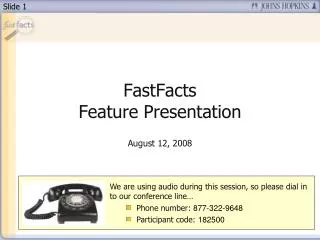
We are using audio during this session, so please dial in to our conference line… • Phone number: 877-322-9648 • Participant code: 182500 FastFactsFeature Presentation August 12, 2008
Today’s Topic • We’ll be taking a look at… • Salary overpayments – how to prevent them, and what to do when they happen
Today’s Presenter • Kelly Mountcastle Manager, Payroll Shared Services • With additional comments from: Debbie Edmonds Manager, Payroll Shared Services
Session Segments • Presentation • Kelly will provide an overview of the overpayment process. • During the presentation, your phone will be muted. • Q&A • After the presentation, we’ll hold a Q&A session. • We’ll open up the phone lines, and you’ll be able to ask questions. • Please keep your questions centered around overpayment policy and procedure. Please discuss your specific employee overpayment questions with Payroll at another time. • The group will answer as many of your questions as time allows.
Contact Us • If you would like to submit a question during the presentation or if you’re having technical difficulties, you can email us at: fastfacts@jhu.edu • You can also send us an instant message! • GoogleTalk – HopkinsFastFacts@gmail.com • AOL Instant Messenger – HopkinsFastFacts • MSN – FastFacts@jhu.edu
Survey • Survey • At the end of this FastFacts session, we’ll ask you to complete a short survey. • Your honest comments will help us to enhance and improve future FastFacts sessions.
Agenda Today, we’ll be taking a look at: • The causes of overpayments • How to prevent overpayments • What to do when an overpayment occurs • Different collection methods • Available resources
Causes of Overpayments Causes: • Retroactive terminations • Retroactive salary decrease (example: decrease in hours) • Retroactive leave of absence • Retroactive fellowship to wage transfer • Reducing the amount or deleting a supplement that has already been paid • Deleting or reducing hours in CATS for a weekly employee/student
Prevention of Overpayments • Timely processing of ISRs • ISR deadlines and Payroll schedules are posted on the HR Shared Services website under the heading “Communications/Deadlines.” • http://ssc.jhu.edu/humanresources/deadlines.html • ISRs can be future dated.
Prevention Continued • BW reports • Check/Direct Deposit Register • Located at: http://ssc.jhu.edu/payroll/forms.html • Account reconciliation • Account reconciliation guide can be found at: http://www.controller.jhu.edu/acct_recon/acct_reconciliation_guide/Acct_Reconciliation_Guide.pdf
Prevention Continued • SAP/BW training • Center for Training and Education • http://training.jhu.edu/html/Main/default.asp • Human Resources will be enhancing training for supervisors and managers.
Claims • The SAP-delivered overpayment solution is to create a “claim.” • The claim represents the amount that has been overpaid. • The system automatically deducts the claim from any money the employee receives, possibly leaving the employee with a zero net pay. • The claim remains on the employee’s record until the claim is collected in full.
Overpayment Advance • Overpayment amounts can not be deducted without the employee’s consent. • JHU’s solution to offset the claim process: create an overpayment advance. • Wage types used by Payroll: • 3041- Salary overpayment advance • 3083- Fellowship overpayment advance • Allows department to discuss repayment options with employee.
Creating an Overpayment Advance • Creating an overpayment advance is a manual process, done by Payroll Shared Services (PRSS) during the Payroll process. • Report is generated in SAP while payroll is processing to identify employees with a claim. • PRSS creates overpayment advance according to report. • Charges the Cost Center/Internal Order the employee was paid from. • If employee is on grant or multiple budgets, overpayment advance is charged to control salary.
Ways to View Overpayment Balances • Monitor after each semi-monthly payroll, or at least monthly. • BW overpayment report: • Human Resources- Payroll Admin- Overpayment Report • Required fields are Org Unit and Personnel Area • Role needed: ZBHR_PA_R_PAV_ORG (BW-HR Payroll Admin View Reports-Org)
Collection of Overpayment • Department is responsible for the initial communication to employee. • Email or letter can be used. • Sample letters are available on Payroll’s website. • Two methods of collection: • Payroll deductions (active employees only) • Personal check (terminated employees)
Payroll Deductions • Easiest and most accurate for active employees. • No manual calculations. • Taxes are automatically adjusted each pay. • Budget is credited each time a deduction is taken from employee’s pay. • Overpayment agreement can be found on Payroll Shared Service’s website, under the heading “Salary Overpayments.” • Fax or email signed agreement to PRSS — department retains original.
Personal Check • Try to reserve this method for terminated employees only. • For current year overpayments, the check is made out for 70% of the gross overpayment (70%= 7.65% FICA, 6% State tax, 16.35% federal tax). • For prior calendar year overpayments, check is made out for 92.35% (7.65% FICA). • Make sure FICA was withheld. If not, employee owes full gross (ex: students). • This process is only an estimate for ease of calculating a pay back amount. • Could result in a remaining balance still due. • There is an automatic refund of excess. • A more accurate net amount can be calculated. Instructions will be posted on Payroll’s website. • Check is made payable to JHU and sent to PRSS for deposit and processing.
Additional Collection Methods • When attempts are unsuccessful, department can use the Overpayment Collection form. • This form is available on Payroll’s website, under the heading “Salary Overpayments.” • Should generally only be used for terminated employees. • Three choices: • Request Payroll to proceed with attempting to collect. • Place with collection agency. • Write off balance.
PRSS Collects Overpayment • PRSS will send two letters to the employee. • The first letter will be sent within days of receiving form from department. • If no response within 30 days, the second letter will be sent. • PRSS will not attempt any further collection after the second letter and will proceed as indicated on the form: • Collection agency • Write off balance
Collection Agency • If the department has made initial contact with the employee and no response from the employee, the overpayment can be sent directly to the collection agency for collection. • Recommended for balances over $100.00. • PRSS will work directly with a collection agency to attempt to collect the overpayment. • 20% of the collected amount will be assessed to the department’s cost center for the collection agency service fee. • If no payment is received, the department will not be assessed the fee. • If collection attempts fail, the remaining balance will be written off.
Write Off Balance • A department can choose to write off the salary overpayment with no employee contact for one of the following reasons: • Minimal balance - PRSS recommends a threshold of less than $100.00. Department’s minimal balances could be different. Please contact your business office for further assistance in determining a good threshold for your department. • Deceased Employee - PRSS recommends that overpayments resulting from death not be collected. • Not practical or appropriate - A determination is made by the Divisional Business Office, and potentially in conjunction with Legal Counsel, that the collection is not practical or appropriate.
Resources • Payroll Shared Services website: • Overpayment agreement • Overpayment Collection form • Sample letters • Instructions to run Check/Direct Deposit Register BW report • Example of payroll deduction vs. check payment when repaying an overpayment • Instructions for calculating more accurate net repayment
Resources Continued • Human Resources Shared Services website: • SAP job aides • Communications/Deadlines • Divisional Business Offices • Threshold for write offs • Divisional Human Resource Offices • Leave of Absence policy and procedures
Conclusion • Prevention is key in minimizing overpayments • Methods of collecting an overpayment • Helpful resources for the department
Q&A • We’re going to open the phone lines now! • There will be a slight pause, and then a recorded voice will provide instructions on how to ask questions over this conference call line. • We’ll be answering questions in the order that we receive them. • We’ll also be answering the questions that were emailed to us during the presentation. • If there’s a question that we can’t answer, we’ll do some research after this session, and then email the answer to all participants. • Please remember to reserve your employee-specific questions for a later time.
Thank You! • Thank you for participating! • We would love to hear from you. • Are there certain topics that you would like us to cover in future FastFacts sessions? • Would you like to be a FastFacts presenter? • Please email us at: fastfacts@jhu.edu
Survey • Before we close, please take the time to complete a short survey. • Your feedback will help us as we plan future FastFacts sessions. • Click this link to access the survey… http://connect.johnshopkins.edu/fastfactssurvey/ Thanks again!