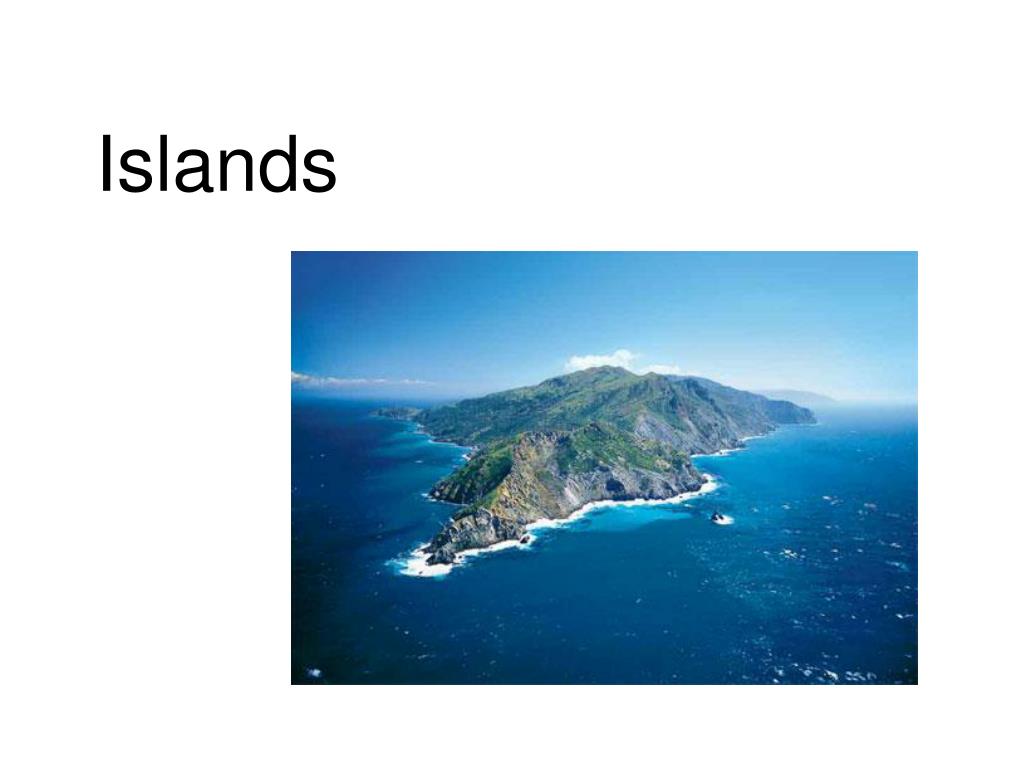
Islands. Islands can serve almost as a laboratory for the study of biogeography. The biota of an island is simpler than that of a continental area, and the interactions are easier to understand. Islands are often depauperate in species numbers relative to mainland areas.
Une image / un lien ci-dessous est fourni (tel quel) pour télécharger la présentation
Politique de téléchargement : le contenu du site vous est fourni TEL QUEL pour votre information et votre usage personnel ; il ne peut être vendu, concédé sous licence ni partagé sur d’autres sites sans l’accord de son auteur.Le contenu vous est fourni TEL QUEL, pour votre information et votre usage personnel uniquement.Téléchargez la présentation en cliquant sur ce lien.Lors du téléchargement, si vous ne parvenez pas à télécharger une présentation, l’éditeur a peut-être supprimé le fichier de son serveur.Pendant le téléchargement, si vous ne parvenez pas à obtenir une présentation, le fichier a peut-être été supprimé par l’éditeur.
Islands are often depauperate in species numbers relative to mainland areas. Only 28 land bird species are found on the Galapagos, the result of maybe 13 colonization events. Some undifferentiated, others apparently derived by speciation within the archipelago. Equivalent area in South America would have a bird fauna 10 to 20 times as rich.
There are three types of islands: • Islands that were originally part of a nearby continent, but were separated by rising sea levels (land-bridge islands). • Islands that are part of a volcanic island arc. • Seamount chains which formed over geological “hotspots”.
The types of islands have different characteristic flora and fauna. Islands formed by isolation from continents would have a biota which would be a subset of that on the continent. It would have changed, however, as the result of independent evolution and extinction. The biota of island arcs and hotspot island chains originally arrived by trans-ocean dispersal. In both cases, several islands exist at one time, creating the possibility for inter-island dispersal and a more complex pattern of evolutionary change.
The ratio of observed species to the expected number declines with distance from New Guinea. Jared Diamond showed that, on very remote islands, the number of species may be less than that predicted by equilibrium theory. This is because of the great difficulty in dispersing to these islands.
Dispersal to islands is typically by a “sweepstakes” route,. The dispersing organisms share adapations that allow them to reach the island, rather than adaptations allowing them to live there once they reach it. This is one factor that restricts the diversity of life on islands.
Long distance dispersal in plants is much more likely. A great many plants are adapted for such dispersal. In addition, the long distance dispersal of a plant species can typically be accomplished by a single spore or seed, where in animals it typically requires a pair of organisms or a pregnant female.
Islands also show high endemicity. All native land birds of the Hawaiian Islands are endemic. Over 40% of plants on isolated oceanic islands are endemic.
Another characteristic that may be seen on islands is ecological release, leading to niche expansion. This may lead to groups of organisms playing ecological roles different from those they might fill on the mainland.
High degree of endemicity 42% of native plants All of mammals and reptiles. Human impact dates from 16th Century. Four islands have been settled. Total human population is now 9,000. In 1959, uninhabited portions were declared a national park. Tourism now major industry – 60-70,000 visitors annually.
On island of Pinta, one male and two female goats were introduced in 1959. In 1973 the populaton was estimated to be about 30,000 (almost 200/square km). Feral cattle, donkeys, horses and pigs also a problem. Introduced rats have probably led to the extinction of native rice rats on seven islands. Introduced plants also a problem. Guava now dominant plant in many areas. Lantana, quinine tree.
Over 1200 species of flowering plants – 95% endemic. 22-24 colonizations by land snails have led to over 1000 species. 47 species and subspecies of songbirds. Biggest difference is that the Hawaiian Islands had been heavily impacted by man before Cook got there in 1778. Banana poka – vine from SA. Sort of a Hawaiian kudzu. Hawaiian Islands contain more than a quarter of the threatened and endangered species in the US.
Also, when a species is lost by extinction, it is more difficult to replace it be immigration than in a mainland situation. For these, and other reasons, islands tend to support fewer species than mainland areas of similar size. Lizards Ants
How do we explain the fact that islands are typically depauperate in species richness relative to mainland areas of comparable size. Originally, this was explained by a nonequilibrium theory of island biogeography which stated that islands are depauperate because they have not had sufficient time to accumulate species by immigration.
In 1963, Robert MacArthur and E.O. Wilson presented a new hypothesis to explain patterns of species richness on islands. Their equilibrium theory of island biogeography proposed that the lower number of species on islands was not the result of insufficient time, but rather the result of an equilibrium process peculiar to all islands.
The equilibrium theory can also be used to explain the effect of size and distance on the number of species found on islands. Consider two islands of similar sizes but different distances from the mainland pool. Since extinction rates are a function of the available resources and should be related to the size of the island, we would expect them to be similar on the two islands. Colonization rates, however, should be greater for the island near the mainland than for the more distant island.
A similar argument can be used to explain the effect of island size. If two islands are of relatively equal distance from the mainland, we can expect colonization rates to be similar. Extinction rates, however, should be greater on the smaller island. Therefore, we expect a higher equilibrium number of species on the large island.
So, the two approaches (nonequilibrium and equilibrium) make very different predictions about the nature of island species. • The equilibrium theory predicts that the number of species will not change over time. The nonequilibrium theory predicts that the number of species should increase with time. • The equilibrium species predicts that, although the number of species will remain relatively constant, the actual makeup of those species will change.
Then, they defaunated the islands by enclosing them in plastic and pumping in methyl bromide to kill all the arthropods. They found that species increased for a while, then reached an asymptote approximately equal to the original number. But the makeup of the species had changed.
Following the publication of the theory, a number of other studies were conducted to examine its validity. A study on plant species on a group of islands off Britain showed that, in that case, the effect of size was indirect. Large islands had a greater degree of habitat heterogeneity, and therefore greater diversity.
Connexion au compte
Connectez-vous pour publier votre contenu sur SlideServe.