Download
1 / 42
420 likes | 536 Vues
This outline presents a comprehensive overview of various components of clustering algorithms, including adaptive and autonomous schemes. Key topics include K-Means and Affinity Propagation, which utilize single and multi-prototype approaches, respectively. The importance of distance metrics, objective functions, and clustering schemes is discussed, highlighting challenges like the limitations of Euclidean distance and the use of alternative similarity measures. The framework includes methods like agglomerative and partitioning clustering. Finally, potential advancements in multi-prototype clustering are suggested.

E N D
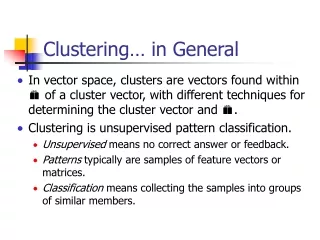
On Mechanism in Clustering Speaker: Caiming Zhong 04-02-2010
Outline • Some main components of a clustering algorithm • A mechanism: Adaptive (Autonomous) scheme, or framework • K-Means: single prototype for one cluster • Affinity Propagation • Multi-prototype based autonomy • Potential topics
Main components of a clustering algorithm • Distance metric (Similarity measure) • Objective function • Clustering scheme
Main components of a clustering algorithm (cont.) • Distance metric (Similarity measure) • Cornerstone for a clustering algorithm. • Euclidean distance is the most used, but doesn’t work some time.
Euclidean vs. Geodesic
Main components of a clustering algorithm (cont.) • A similarity measure is not always a metric • Conventional similarity measures
Main components of a clustering algorithm (cont.) • Special similarity measures • Point symmetry distance
Main components of a clustering algorithm (cont.) • Special similarity measures • Path-based distance (minmax diatance)
Main components of a clustering algorithm (cont.) • Objective Function • What objective function to be optimized? • K-Means: MSE, compactness • Path-based: connectivity • Point symmetry: Symmetry
Main components of a clustering algorithm (cont.) • Clustering framework • Split-and-merge • Agglomerative • Divisive • Partitioning • Density connectivity • …
A mechanism: Autonomous framework • Generally a clustering process of clustering scheme stops when a certain criterion is satisfied. • The criterion is usually user-specified parameters. • The number of clusters • The number of iterations • If the criterion is not a specific threshold, but convergence (the stable state is achieved), we can say “Autonomous framework”
A mechanism: Autonomous framework (cont.) • K-Means is a typical autonomous framework • Repeatedly move prototypes (representative points of a cluster), until no prototype changed • Affinity propagation
A mechanism: Autonomous framework (cont.) • A multi-prototype clustering algorithm
Potential topics • Apply existing mechanisms onto Graph (K-MST Graph) , in breeding. • Improve the existing mechanisms. • Exploit new mechanism.
References • R. XU, D. WUNSCH, Survey of clustering algorithms. IEEE Transactions on Neural Networks, 2005. • M. Su, C. Chou, A modified version of the K-means algorithm with a distance based on cluster symmetry, IEEE Transactions on PAMI, 2001. • S, Bandyopadhyay, S. Saha, GAPS: A clustering method using a new point symmetry-based distance measure, Pattern Recognition, 2007. • B. Fischer, J. Buhmann, Path-Based Clustering for Grouping of Smooth Curves and Texture Segmentation, IEEE Transactions PAMI, 2003.
References (cont.) • H. Chang, D. Yeung, Robust path-based spectral clustering,Pattern recognition, 2008. • B. Frey, D. Dueck, Clustering by passing messages between data points,Science, 2007. • M. Liu, X. Jiang, AC. Kot, A multi-prototype clustering algorithm, Pattern Recognition, 2009.