### Conservation of Mass and Atoms in Chemical Reactions ###
In chemical reactions, the law of conservation states that mass and atoms are always conserved. This means that the total mass of reactants equals the total mass of products. For example, starting with 18 kg of reactants results in 18 kg of products. Chemical reactions do not create or destroy matter; they only rearrange it. However, volume and molecules may not be conserved. Understanding these principles is crucial for balancing chemical equations, such as when ethanol reacts with oxygen to produce carbon dioxide and water, demonstrating conservation of mass. ###

### Conservation of Mass and Atoms in Chemical Reactions ###
E N D
Presentation Transcript
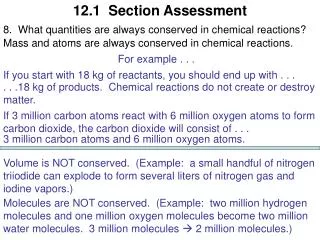
8. What quantities are always conserved in chemical reactions? Mass and atoms are always conserved in chemical reactions. For example . . . If you start with 18 kg of reactants, you should end up with . . . . . .18 kg of products. Chemical reactions do not create or destroy matter. If 3 million carbon atoms react with 6 million oxygen atoms to form carbon dioxide, the carbon dioxide will consist of . . . 12.1 Section Assessment 3 million carbon atoms and 6 million oxygen atoms. Volume is NOT conserved. (Example: a small handful of nitrogen triiodide can explode to form several liters of nitrogen gas and iodine vapors.) Molecules are NOT conserved. (Example: two million hydrogen molecules and one million oxygen molecules become two million water molecules. 3 million molecules 2 million molecules.)
10. Balance this equation: C2H5OH(l) + O2(g) CO2(g) + H2O(g) Show that the balanced equation obeys the law of conservation of mass. 46 g First, I’d like to show how the unbalanced equation disobeys the law of conservation of mass To do this, I’ll need to calculate the molar mass of each reactant and each product . . . 12.1 Section Assessment C2H5OH: C: 2 x 12 = 24 H: 6 x 1 = 6 O: 1 x 16 = 16 ----------------------- 46 g/mol
10. Balance this equation: C2H5OH(l) + O2(g) CO2(g) + H2O(g) Show that the balanced equation obeys the law of conservation of mass. 46 g 32 g First, I’d like to show how the unbalanced equation disobeys the law of conservation of mass To do this, I’ll need to calculate the molar mass of each reactant and each product . . . 12.1 Section Assessment O2: O: 2 x 16 = 32 ----------------------- 32 g/mol
10. Balance this equation: C2H5OH(l) + O2(g) CO2(g) + H2O(g) Show that the balanced equation obeys the law of conservation of mass. 46 g 32 g 44 g First, I’d like to show how the unbalanced equation disobeys the law of conservation of mass To do this, I’ll need to calculate the molar mass of each reactant and each product . . . 12.1 Section Assessment CO2: C: 1 x 12 = 12 O: 2 x 16 = 32 ----------------------- 44 g/mol
10. Balance this equation: C2H5OH(l) + O2(g) CO2(g) + H2O(g) Show that the balanced equation obeys the law of conservation of mass. 46 g 32 g 44 g 18 g First, I’d like to show how the unbalanced equation disobeys the law of conservation of mass To do this, I’ll need to calculate the molar mass of each reactant and each product . . . 12.1 Section Assessment H2O: H: 2 x 1 = 2 O: 1 x 16 = 16 ----------------------- 18 g/mol
10. Balance this equation: C2H5OH(l) + O2(g) CO2(g) + H2O(g) Show that the balanced equation obeys the law of conservation of mass. 46 g 32 g 44 g 18 g First, I’d like to show how the unbalanced equation disobeys the law of conservation of mass To do this, I’ll need to calculate the molar mass of each reactant and each product . . . 12.1 Section Assessment 44 + 18 = 62 grams of products 46 + 32 = 78 grams of reactants You can’t have 16 grams of matter just disappear like that. In its unbalanced state, the equation violates the law of conservation of matter. It needs to be balanced!
12.1 Section Assessment 10. Balance this equation: C2H5OH(l) + O2(g) CO2(g) + H2O(g) Show that the balanced equation obeys the law of conservation of mass. C2H5OH(l) + O2(g) CO2(g) + H2O(g) 3 2 3 2 1 2 C = C = H = H = O = O = 6 6 2 7 5 7 3 3
12.1 Section Assessment 10. Balance this equation: C2H5OH(l) + O2(g) CO2(g) + H2O(g) Show that the balanced equation obeys the law of conservation of mass. C2H5OH(l) + O2(g) CO2(g) + H2O(g) 3 2 3 32 g 44 g 18 g 46 g x 1 x 3 x 2 x 3 88 g 54 g 46 g 96 g 46 g + 96 g = 142 g 88 g + 54 g = 142 g REACTANTS PRODUCTS = (in terms of mass, anyway)
REALITY CHECK Don’t forget that one “mole” of a material = 6.022 x 10²³ molecules* of that material. *If the material is a noble gas or a metal, subsitute the word “atoms” for “molecules”. If the material is ionic, substitute “forumula units” for “molecules”.