Understanding Gases: Kinetic Theory, Phase Diagrams, and Pressure Measurement
This chapter explores the fundamental concepts of gas behavior through the lens of kinetic theory. Learn how gases move, the relationships between temperature, pressure, and volume, and how phase diagrams illustrate gas properties. The chapter covers key laws such as Boyle's and Charles' Law, as well as the Combined Gas Law, providing insights into real-world applications. Through engaging videos and practical examples, understand how molecular motion affects gas behavior and how pressure is measured in various units, including the implications of vacuum and absolute pressure in experiments.

Understanding Gases: Kinetic Theory, Phase Diagrams, and Pressure Measurement
E N D
Presentation Transcript
Chapter 4 - Gases • Movie – phase diagrams • Kinetic Theory • Pressure Measurement • Units • Unit Conversions • Boyle & Charles • Combined Gas Law
Movie – Phase Diagrams • Take home message: • how gases move around • distances between molecules • Other • There is more information in the movie – it’s all chemistry. • Much of it is “common sense” with scientific labels.
Kinetic Theory • Define Temperature • Define Source of Pressure • Relate Molecular Motion to Gas Behavior.
Kinetic Theory – Define Temperature • Temperature relates to the speed of molecular motion. • Fast moving molecules = higher temp. • Solids vibrate • Liquids wiggle (movie) • Gases move in straight lines • Actually, temp. relates to kinetic energy which is mass times speed. • Fat molecules move slower at same temp. • Skinny molecules move faster • (Geo Metro vs. GMC Suburban)
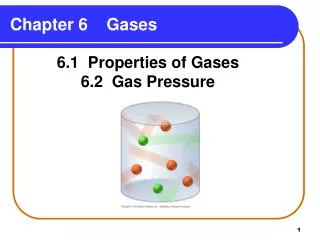
Kinetic Theory - Source of Pressure • Pressure is the force of gas atoms bouncing off the walls of a container. BIFF POW
Kinetic Theory:Molecular Motion Gas Behavior • Hit the wall = pressure • Gas collisions are perfect bounces. • T = Moving faster P__ • T = moving slower P__ • More molecules P__ • Smaller Bottle P__
How do we measure pressure? • Definition: P = force area • Wall Barometer (Fig. 4.8) • air pushes on a diaphram against a spring • calibrate the scale • Manometer • Air pushes on a mercury column.
Pressure Unit Conversions • We always get to convert these! • 1 atm 760 torr = 760 mmHg = 14.7 psi = 101.3 kPa • Forget about “bar”
Vacuum • A vacuum is a truly empty space. • No gas molecules. • Pressure = 0.0000000 atm. • Real experiments can only get to 0.00000000000000001 atm or so.
What is vacuum? • Vacuum- literally translated, the word describes the volume from which all the air has been totally removed. • However, so far nobody has succeeded in achieving such a condition. Scientifically the highest vacuum yet reached is in the range of 10-14 torr. This result has been achieved during a test by IBM Thomas J. Watson Research Center, New York, USA, October 1976, in a cryogene system where the temperature dropped to minus 269 °C. • Even at this low pressure thousands of gas molecules were detected per cm3. Also far out in space the presence of gas has been measured. http://www.busch.com.au/whatisvacuum.htm
Absolute vs. Gauge • Bike Tires? 45 psi • Car Tire? • The psi values we use are usually relative to atmospheric pressure. • “Gauge” pressure means 1 atm + the reading. • “Absolute” means 0.000 atm + the reading • Actual pressure in bike tire is 45 psi + 14.7 psi = 59.7 psi! • Chemistry lab experiments use absolute pressure.
Pressure - Volume • Boyles’ Law • Change the volume of a gas sample • See what the pressure does (graph it). • Avogadro’s Law • Trap different volumes of gas in the syringe. • See what the pressure does.
Pressure – Volume Math • Boyle’s Law says that: PV = k, P= k/V • If you do 2 experiments: • 1st Experiment: 1.0 atm, 5.0 mL • 2nd Experiment: ? atm, 25.0 mL
Pressure - Temperature • Charles’ Law says that:Pressure Temperature • P T • P T • Double temperature double pressure • Careful: • You have to use Kelvin units for temperature.
Pressure – Temperature Math • Charles’ Law says that: P = kT, k = P/T • If you do 2 experiments: • 1st Experiment: 1.0 atm, 0 °C • 2nd Experiment: ? atm, 100 °C
Combined Gas Law • We can shove Boyle & Charles together:
Combined Gas Law - Math • These problems are all about setting them up right • At 56°C and 868 torr, a gas takes up 4.30 L. What will the pressure be if the volume is changed to 6.36 L and cooled to 12 °C? Case 1 Case 2 P _868 torr_ _???_____ V _4.30 L___ _6.36 L_ T _56°C=329K_ _12°C=285K_
Combined Gas Law - Math • Once you make the table, fill into the big equation. • Answer: 508.4 torr
Combined Gas Law - Math • Is out answer good? • P went down. • Sample was cooled. • Volume went up. • Sounds ok by kinetic theory…