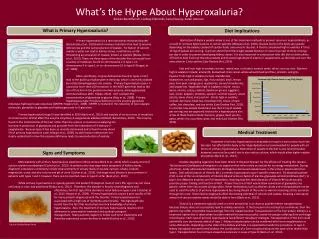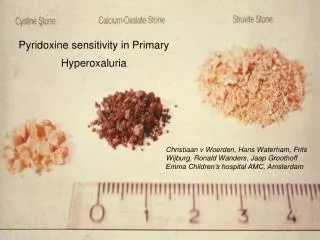
Pyridoxine sensitivity in Primary Hyperoxaluria
380 likes | 584 Vues
Pyridoxine sensitivity in Primary Hyperoxaluria . Christiaan v Woerden, Hans Waterham, Frits Wijburg, Ronald Wanders, Jaap Groothoff Emma Children’s hospital AMC, Amsterdam. What has brought them to the top?. What made them the greatest?. genes?. environment?.

Pyridoxine sensitivity in Primary Hyperoxaluria
E N D
Presentation Transcript
Pyridoxine sensitivity in Primary Hyperoxaluria Christiaan v Woerden, Hans Waterham, Frits Wijburg, Ronald Wanders, Jaap GroothoffEmma Children’s hospital AMC, Amsterdam
What has brought them to the top? What made them the greatest? genes? environment?
Primary Hyperoxaluria I (PHI): peroxisomal enzyme (AGT) deficiency in the liver
Role of pyridoxine (B6) • Essential co-factor of AGT • mutation Gly82Glu: inhibits B6 binding no AGT activity • Reduction of oxalate excretion by B6 in B6 deficiency • Reduction oxalate excretion pharmacological dosages B6 in 30% of PH1 patients W Europe
PH1: extreme heterogenous phenotypical expression No symptoms, sole kidney stones, nephrocalcinosis, UTI or Interstitial nephritis & fibrosis, ESRD systemic oxalosis: retinopathy , blunted vision, bone pain, fractures, growth, arthopathy peripheral neuropathy, heartblock, myocarditis, skin calcification, peripheral, gangreen, pancytopenia, splenomegaly, vascular calcification, arterial wall stiffening
Genotype-phenotype association? Impact B6 sensitivity? AGT mutation AGT metabolic activity level of endogenous oxalate Clinical severity oxalate diet, hydration medication Infection Renal handling oxalate
Mrs. A • Age 22: kidney stone Hyperoxaluria (5x normal) & hyperglycoluria • Liver biopsy: AGT residual activity of 48% • Reduction of hyperoxaluria to “high normal” (0.057 mmol/mmol kreat) under pyridoxine 50 mg • Age 38: good health, 1 new stone removed, US small calcifications
Mrs. B, sister of Mrs. A • Age 6: kidney stones, surgical removal • Age 30: diagnosis PH1, lost to follow-up • Age 50: kreat 200 μmol/l, nephrocalcinosis • Liver biopsy: 15% AGT-activity • Age 51: ESRD
Mrs. C, sister of A & B • Age 48: ESRD (1 year after diagnosis B) • AGT-activity 9% • Age 49: renal tx • Nephrocalcinosis renal graft
Mrs. C, sister of A & B • Age 48: ESRD (1 year after diagnosis B) • AGT-activity 9% • Age 49: renal tx • Nephrocalcinosis renal graft • All 3 sisters homozygous G170R mutation
AGT in liver biopsy specimens O Immunoreactive AGT -; • immunoreactive AGT + (Danpure ea J Inher Metab Dis 17: 487-499, 1994)
AGT deficiency: over 50 mutations liver biopsy: immunoreactivity enzyme activity • Protein not synthesized (nonsense m) - - • Protein synthesized OK but inactive + - • Protein synthesized OK but unstable: • Protein rapidly degraded + - • Protein aggregates + +/- • Protein mistargeting: mitochondrion + +
Gly82Glu (Pyr-) mutation abolishes pyridoxine (PLP) binding (imm+/enz-) Gly41Arg (Pyr-) abolishes contact 2 monomers: destablilisation aggregation AGT From Zhang et al, JMB, 2003
Minor allele: 4% population Europe/USA Normal AGT: peroxisomal localisation by way of Peroxisomal Targeting Sequence 1 as folded dimer Minor allele: P11L aa replacement: catalytic act AGT to 30% dimerisation AGT in vitro at 37° 5% mitochondrial location AGT by a weak Mitochondrial Targeting Sequence at N-terminus Mitochondrial AGT import only as an unfolded monomer 2 polymorphic variants: a “major” & “minor” allele
G170R & F152I activity of P11L-induced mitochondrial mistargetingto 90% by unfolding the AGT from Danpure et al
G170R & F152I activity of P11L-induced mitochondrial mistargetingto 90% by unfolding the AGT pyridoxine may increase the activity of 10% peroxisomal AGT association pyridoxine sensitivity? from Danpure et al
Association B6 sensitivity - outcome 1. the Dutch experience • follow-up PH 1972-2002 • search for patients: • Dutch Registration Renal Replacement Therapy (RENINE) • Dutch Society of Pediatric Nephrology • Dutch Society of Nephrology • if no answer: contact by phone • review of all available medical charts • Total number of patients: 62 • PH1: 57 PH2: 1 • PH-unidentified: 4 • Prevalence PH1 = 2.9 per 106 • Incidence PH1 = 0.15 per 106 per year v Woerden et al, NDT 18, 2003 & Kidney Int 66, 2004
Outcome: renal function 57 at diagnosis 30 preserved renal function 27 renal insufficiency 19 ESRD
Outcome: renal function 57 at diagnosis 30 preserved renal function 27 renal insufficiency 19 ESRD 2 improved/ 2 stabilized 4 ESRD at follow-up 24 preserved renal function 5 ESRD/ low GFR 28 ESRD/ low GFR 11 death
Clinical & biochemical parameters in relation to renal insufficiency RR = relative risk, 95%CI = 95% confidence interval
Mutation analysis: patients • 33/57 patients of 26 families • Median age onset of symptoms/diagnosis 5.7/6.6 (0.1-50/57) • Mean follow up after diagnosis 12.5 years (0.1- 49) • 20/33 patients onset < 18th years of age • 6/33 patients onset < 1st year of age
Mutations • 11 patients homozygous for G170R - pyr+ • 4 patients homozygous for P152I - pyr+ • 3 patients homozygous for 33InsC - pyr- • 3 patients homozygous for G82R - pyr- • 1 patient homozygous for G170R & V336D mutation - pyr- • 11 patients compound heterozygous - pyr-
G170R homozygosity (Pyr+) 11 at diagnosis 6 preserved renal function 5 ESRD 1 ESRD (not treated) 5 kidney Tx: all B6 responsive at follow-up 5 preserved function kidney Tx: preserved function 3 preserved function
F152I homozygosity (Pyr+) 4 at diagnosis 2 preserved renal function 2 ESRD 1 dialysis 1 kidney Tx: B6 responsive at follow-up 2 preserved function 1 preserved function
33InsC homozygosity (pyr-) 3 at diagnosis 3 neonatal ESRD 1 deceased 2 liver kidney Tx at follow-up 1 preserved function 1 deceased (liver failure)
G82R (pyr-) 3 at diagnosis 3 normal GFR 1 preserved 1decreased GFR 1 ESRD at follow-up 1 liver kidney-tx GFR decreasing
Mrs. B, sister of Mrs. A • Age 6: kidney stones, surgical removal • Age 30: diagnosis PH1, lost to follow-up • Age 50: kreat 200, nephroclacinosis • Liverbiopsy: 15% AGT-activity • Age 51: ESRD Follow-up (8 years): • Same year renal Tx, calcification Tx kidney, GFR 46 at 5 years follow up • Normalisation oxalate excretion under pyridoxine
Mrs. C, sister of A & B • Age 48: ESRD (1 year after diagnosis B) • AGT-activity 9% • Age 49: renal tx • Nephrocalcinosis graft Follow-up (7 years): • Normalisation oxalate excretion under B6 • GFR graft 56 after 5 years of follow-up • All 3 sisters homozygous G170R mutation
The American experienceMonico et al Am J Nephrol 2005 • 23 PH1 patients • 6 homozygotes G170R • 1 homozygous F152I • Homozygotes G170R & F152I B6 responsive and high AGT residual act (19 vs.10 heterozygotes G170R & 8 non-G170R) • No follow up • Conclusion: association B6 and G170R & F152I
The German experienceHoppe et al, Am J Nephrol 2005 • Patients: 65 PH; 42 PH1; 12 unclassified • 7 B6 full response - no mutation found - AGT 7.2 (1 patient) • 9 B6 partial response (25-50%)- 4 heterozygous G170R - AGT 4.7 • Time interval symptoms - diagnosis: 1-31 year • 17 no B6 response - AGT 5.2 • 25 (38%) ESRD - 2 homozygous G170R • 6 isolated kidney tx - 1 successful, 3 recurrences, 2 failed
The Israel experienceFrishberg et al Am J Nephrol 2005 • 56 PH1 patients • 21 families • 15 mutations, 1 nonsense, 13 missense mutations • No B6 responsiveness, AGT-activity near to 0 • Prevalent phenotype; early onset CRF • 20 ESRD childhood (18†), 15 at infancy • Clinical presentation 43 < age 5 • 12 asymptomatic at diagnosis
Conclusions pyridoxine sensitive PH1 • Homozygosity G170R and F152I & minor allele, others? • 20-30% PH1 patients Western Europe/USA • Relatively late onset: adult patients!! • Diagnosis often delayed • Good outcome if early diagnosed • no indication for liver Tx
PH1 group Emma children’s Hospital AMC Christiaan van Woerden Resident Paediatrics Simone Denis Technician Hans Waterham Molecular Geneticist Ronald Wanders Biochemist Carla Annink Technician | Marinus Duran Clinical Chemist Frits Wijburg Pediatrician Metabolic Diseases Jaap Groothoff Pediatric Nephrologist
AN Bosschaart (Enschede) WT v Dorp (Haarlem) MAGL ten Dam (Nijmegen) CFM Franssen (Groningen) IH Go (Nijmegen) JJ Homan vd Heide (Groningen) JP v Hooff (Maastricht) F Th Huysmans (Leiden) JE Kist-van Holthe tot Echten (Leiden) W Koning-Mulder (Enschede) G Kolsters (Zwolle) MR Liliën (Utrecht) S Lobatto (Hilversum) LAH Monnens (Nijmegen) J Le Noble (Schiedam) C Ramaker (Amsterdam) EMA vd Veer (Amsterdam) ED Wolff (Rotterdam) R Zietse (Rotterdam) Participating centres