Understanding Vertical and Horizontal Transformations of Functions
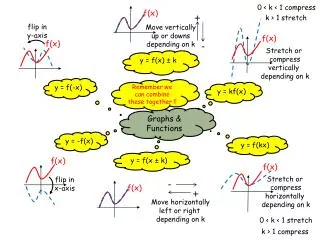
This guide explores the concepts of stretching, compressing, and flipping functions both vertically and horizontally. It covers vertical transformations represented by ( y = f(x) pm k ), where ( k ) determines movement up or down, and stretching or compressing effects according to ( k ) values. Horizontal transformations including ( y = f(kx) ) showcase stretching or compressing along the x-axis, with discussions on flipping functions in the x-axis using ( y = -f(x) ). Join the journey of combining these transformations to analyze function behavior through graphs.

Understanding Vertical and Horizontal Transformations of Functions
E N D
Presentation Transcript
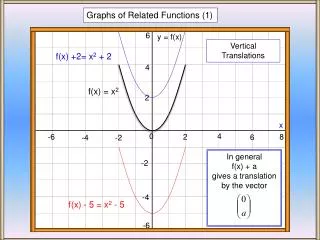
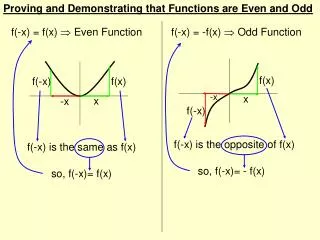
0 < k < 1 compress f(x) f(x) f(x) + k > 1 stretch f(x) flip in y-axis Move vertically up or downs depending on k - Stretch or compress vertically depending on k y = f(x) ± k f(x) f(x) y = f(-x) Remember we can combine these together !! y = kf(x) Graphs & Functions y = -f(x) y = f(kx) y = f(x ± k) Stretch or compress horizontally depending on k flip in x-axis - + Move horizontally left or right depending on k 0 < k < 1 stretch k > 1 compress
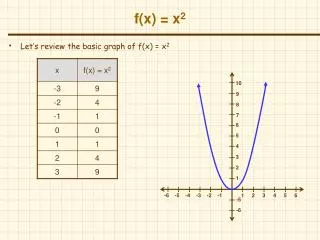
(-2,1) (3,2) y = (x + 2)2 + 1 y = x2 - 3 y =2(x - 3)2 + 2 (0,-3) Graphs of the form y = k(x±a)2 + b y = x2 + 2 y =0.5(x - 1)2 - 2 y = -(x + 1)2 + 2 (0,2) (-1,2) flip in x-axis (1,-2)