Understanding Photosynthesis: Light Reactions and the Calvin Cycle Explained
Photosynthesis is a vital process where plants convert sunlight into energy. This complex reaction encompasses two stages: the Light Reactions and the Calvin Cycle. In the Light Reactions, photons energize electrons in chlorophyll, producing ATP and NADPH, while splitting water to release oxygen. The Calvin Cycle, occurring in the stroma, utilizes ATP and NADPH to fix carbon dioxide into glucose. Notably, adaptations like C4 and CAM pathways help some plants thrive in extreme conditions, reducing photrespiration and conserving water.


Understanding Photosynthesis: Light Reactions and the Calvin Cycle Explained
E N D
Presentation Transcript
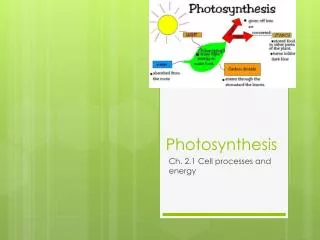
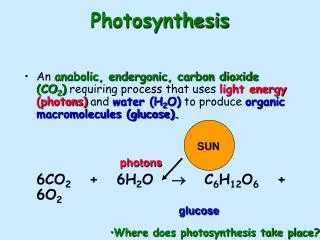
SUN photons glucose Photosynthesis 6CO2 + 6H2O C6H12O6 + 6O2
Redox Reaction The transfer of one or more electrons from one reactant to another Two types: 1. Oxidation is the loss of e- 2. Reduction is the gain of e-
Oxidation 6CO2 + 6H2O C6H12O6 + 6O2 glucose Oxidation Reaction The loss of electrons from a substance or the gain of oxygen. Carbon dioxide Oxygen Water
Reduction 6CO2 + 6H2O C6H12O6 + 6O2 glucose Reduction Reaction The gain of electrons to a substance or the loss of oxygen.
Two Parts of Photosynthesis Two reactions make up photosynthesis: 1.Light Reaction or Light Dependent Reaction - Produces energy from solar power (photons) in the form of ATP and NADPH. SUN
Light Reaction (Electron Flow) • Occurs in the Thylakoid membranes • During the light reaction, there are two possible routes for electron flow: A. Cyclic Electron Flow B. Noncyclic Electron Flow
P Cyclic Electron Flow • Occurs in the thylakoid membrane. • Uses Photosystem I only • P700 reaction center- chlorophyll a • Uses Electron Transport Chain (ETC) • Generates ATP only ADP + ATP
e- Primary Electron Acceptor SUN e- ATP produced by ETC e- Photons e- P700 Accessory Pigments Photosystem I Cyclic Electron Flow Pigments absorb light energy & excite e- of Chlorophyll a to produce ATP
Noncyclic Electron Flow • Occurs in the thylakoid membrane • Uses Photosystem II and Photosystem I • P680 reaction center (PSII) - chlorophyll a • P700 reaction center (PS I) - chlorophyll a • Uses Electron Transport Chain (ETC) • Generates O2, ATP and NADPH
Primary Electron Acceptor 2e- Enzyme Reaction Primary Electron Acceptor 2e- 2e- ETC 2e- SUN 2e- NADPH P700 Photon ATP P680 Photon H2O 1/2O2+ 2H+ Photosystem I Photosystem II Noncyclic Electron Flow H2O is split in PSII & ATP is made, while the energy carrier NADPH is made in PSI
Noncyclic Electron Flow • ADP + ATP • NADP+ + H NADPH • Oxygen comes from the splitting of H2O, not CO2 H2O 1/2 O2 + 2H+ P
Chemiosmosis • Powers ATP synthesis • Takes place across the thylakoid membrane • Uses ETC and ATP synthase (enzyme) • H+ move down their concentration gradient through channels of ATP synthase forming ATP from ADP
SUN (Proton Pumping) H+ H+ Thylakoid E T PS I PS II C high H+ concentration H+ H+ H+ H+ H+ H+ Thylakoid Space H+ ATP Synthase low H+ concentration ADP + P ATP H+ Chemiosmosis
STROMA– where Calvin Cycle occurs Outer Membrane Thylakoid Granum Inner Membrane Chloroplast Thylakoid Membrane– where light reactions occur
Two Parts of Photosynthesis 2. Calvin Cycle or Light Independent Reaction • Also called Carbon Fixation or C3 Fixation • Uses energy (ATP and NADPH) from light reaction to make sugar (glucose).
Calvin Cycle • Carbon Fixation (light independent reaction) • C3 plants (80% of plants on earth) • Occurs in the stroma • Uses ATP and NADPH from light reaction as energy • Uses CO2 • To produce glucose: it takes 6 turns and uses 18 ATP and 12 NADPH.
(36C) (6C) 6C-C-C-C-C-C (unstable) 6CO2 6C-C-C 6C-C-C 12PGA (36C) 6ATP 6ATP (30C) 6C-C-C-C-C 6NADPH 6NADPH RuBP (36C) 6C-C-C 6C-C-C 6ATP 12G3P (30C) (6C) C3 C-C-C-C-C-C Glucose glucose Calvin Cycle (C3 fixation)
C3 Glucose Calvin Cycle Remember: C3 = Calvin Cycle
Oxygen (O2) Carbon Dioxide (CO2) Guard Cell Guard Cell Stomata (stoma) Pores in a plant’s cuticle through which water vapor and gases(CO2 & O2) are exchanged between the plant and the atmosphere. Stoma Found on the underside of leaves
Photorespiration • Occurs on hot, dry, bright days • Stomates close • Fixation of O2 instead of CO2 • Produces 2-C molecules instead of 3-C sugar molecules • Produces no sugar molecules or no ATP
Photorespiration Because of photorespiration, plants have special adaptations to limit the effect of photorespiration: 1. C4 plants 2. CAM plants
C4 Plants • Hot, moist environments • 15% of plants (grasses, corn, sugarcane) • Photosynthesis occurs in 2 places • Light reaction - mesophyll cells • Calvin cycle - bundle sheath cells
Malate-4C sugar Malate C-C-C-C C-C-C-C Transported CO2 CO2 C3 Vascular Tissue glucose C-C-C ATP PEP C-C-C Pyruvic Acid Mesophyll Cell Bundle Sheath Cell C4 Plants
CAM Plants • Hot, dry environments • 5% of plants (cactus and ice plants) • Stomates closed during day • Stomates open during the night • Light reaction - occurs during the day • Calvin Cycle - occurs when CO2 is present
Night (Stomates Open) Day (Stomates Closed) Vacuole C-C-C-C C-C-C-C C-C-C-C CO2 Malate Malate Malate CO2 C3 C-C-C ATP C-C-C glucose PEP Pyruvic acid CAM Plants
Question: Why do CAM plants close their stomata during the day?
Cam plants close their stomata in the hottest part of the day to conserve water