The simplest Matter
Explore atomic number, mass number, isotopes, atomic mass, metals, nonmetals, and metalloids. Learn terms like protons, neutrons, and electrons and the experiment theories of Dalton, Thomson, and Rutherford.

The simplest Matter
E N D
Presentation Transcript
The simplest Matter Sci 11.2
Atomic number: • Number of protons in an atom • Ex: all Cl atoms have 17 p+
Mass number: • sum of protons and neutrons in an atom • Ex: 35Cl (chlorine 35) 17 p+, 18 n 37Cl (chlorine 37) 17 p+, 20 n
Isotopes: • Atoms of the same element with different numbers of neutrons • Ex: 35Cl, 37Cl, protium, deuterium, tritium p+ n p+ p+ n n Isotopes of hydrogen
Atomic mass (weight): • Average mass of isotopes of that element • Ex: 76% Cl is 35Cl, 24% is 37Cl avg. is 35.45 37Cl 24.2% 35Cl 75.8%
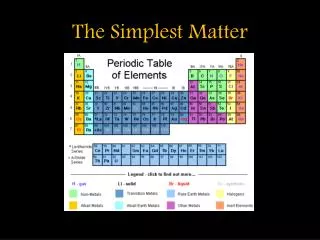
Metals: • Shiny or metallic luster • Good conductors of heat and electricity • Solids at room temp. (except Hg) • Malleable
Nonmetals: • 97% of your body • Usually not shiny • Lousy conductors • Many are gasses • brittle
Metalloids: • Characteristics of metals and nonmetals • used to make semiconductors
19 K 39.098 Atomic # Atomic symbol Atomic mass
term symbol, definition / description Element Electron Proton Neutron Electron cloud - matter made of only 1 kind of atoms - cannot be broken down to simpler substance - e-, negatively charged subatomic particles - outside nucleus, much smaller than a p+ - p+, positively charged subatomic particles - inside nucleus - n, neutral subatomic particles - inside nucleus n - areas around nucleus - where electrons are most likely found
Theorist type of experiment, how he pictured an atom Dalton Thomson Rutherford No experiments Atom is a hard sphere (like a BB) Magnet with cathode ray tube Electrons in atom like plums in pudding Shot alpha particles through gold foil Nucleus with protons and neutrons
term definition / description Atomic number Isotope Mass number Atomic mass Metals Nonmetals Metalloids - different for every element - number of p+, equal to e- if no charge - same element with different number of n - sum of protons and neutrons - average mass of all isotopes - shiny, good conductors of heat and elec. - solid at room temp, malleable/ductile - opposite metals, dull, bad conductors, brittle - in between metals and nonmetals - some shiny, some used for semiconductors