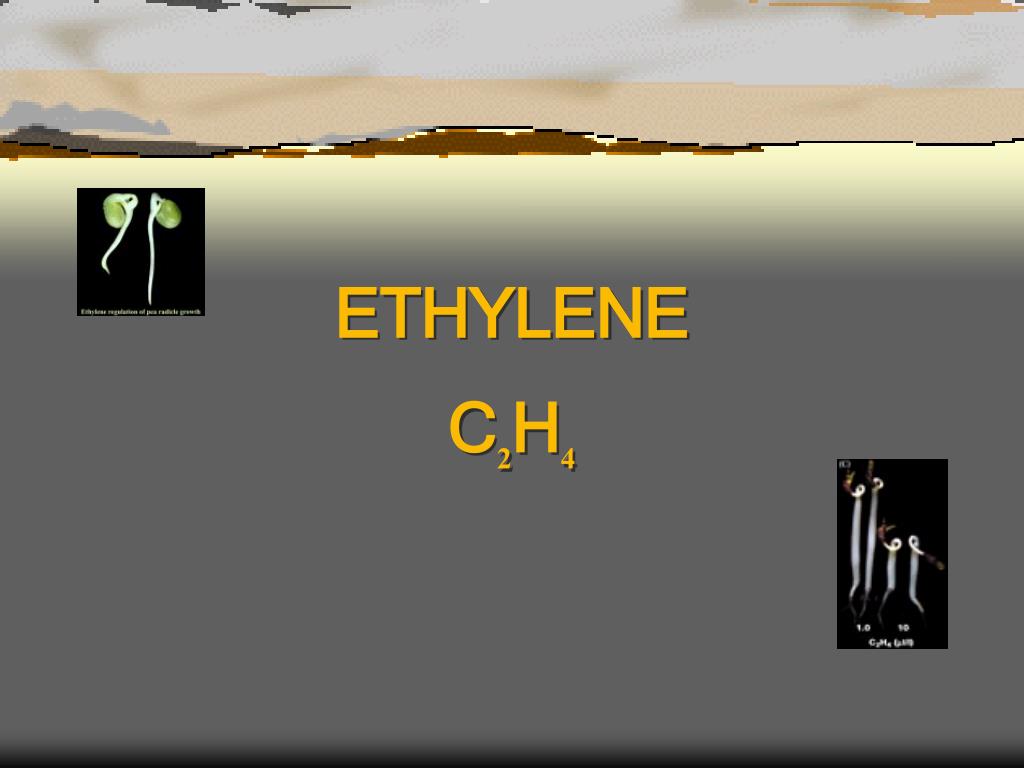
ETHYLENE C 2 H 4. Plant Hormone. Regulatory functions in growth and development Stimulators or inhibitors. Physiological Effects of Ethylene. Normal growth and development Stress response biotic and abiotic. Ethylene in organisms. Animal Production: not normal Effect:
Une image / un lien ci-dessous est fourni (tel quel) pour télécharger la présentation
Politique de téléchargement : le contenu du site vous est fourni TEL QUEL pour votre information et votre usage personnel ; il ne peut être vendu, concédé sous licence ni partagé sur d’autres sites sans l’accord de son auteur.Le contenu vous est fourni TEL QUEL, pour votre information et votre usage personnel uniquement.Téléchargez la présentation en cliquant sur ce lien.Lors du téléchargement, si vous ne parvenez pas à télécharger une présentation, l’éditeur a peut-être supprimé le fichier de son serveur.Pendant le téléchargement, si vous ne parvenez pas à obtenir une présentation, le fichier a peut-être été supprimé par l’éditeur.
Ethylene in organisms Animal Production: not normal Effect: 82+ % as anesthetic in 15 second ignition at humidity lower than 56 %
Ethylene in organisms Bacteria Bacterial rot of cauliflower Fungi Pennicilium digitatum Aspergillus flavus Alternaria solani
Ethylene in organisms Neljubov(1901): Gaseous hydrocarbon olefin Triple response in etiolated pea seedlings Cousins (1910): Orange and banana in the same shipment
Ethylene Diffusibility Easily released from tissues Diffuse through the gas phase intercellular and outside Rapid and sensitive response system Active concentration: 10 ppb
Synthesized in most tissues of almost all higher plants Easily isolated and quantified Also found in gymnosperms lower plants bacteria
Ethylene Production Environmental effect * O2 O2 C2H4 (except rice) * Temperature apple T P peanut / plum T P * CO2 apple P sweet potato P bean no effect
Ethylene Production Other hormones Auxin: activate production: 10x GA: activate in bean citrus blueberry inhibit in soybean seedling CK: activate in bean blueberry sorghum ABA: activate in leaf and fruit inhibit in seed and soybean seedling
ACC Synthase or ACCS Rate-limiting step of pathway SAM to ACC ACCS level Hormone levels Growth environment Physiological environment Developmental environment
ACC Synthase or ACCS Amino acid sequences of tomato, apple, squash and zucchini Share 40% identity and 80% similarity Contain 7 highly conserved regions
Ethylene Perception by receptors Signal transduction Responses
Ethylene binding Ethylene receptors Hypothesis Reversibly binding to a receptor through a transition metal
Ethylene-binding components Membrane bound Solubility Chromatographic behaviors Sensitive to heat protease sulfhydryl agent Nature of protein
Ethylene-binding proteins (EBP): Various tissues and plants tobacco, bean, Arabidopsis Specific High affinity Saturable Characteristics of receptor binding moiety facing the apoplast
Ethylene binding protein EBP of Phaseolus vulgaris Heterotrimer or Heterotetramer Subunits of ca. 12 to 14 kDa Integral membrane protein
ETR Receptor found in Arabidopsis Dimer Subunits of 79 to 83 kDa 3 transmembrane segments
2-component signaling pathway Phosphotransfer between two types of signal transducers Sensory kinase (input & kinase domains) Response regulator (receiver & output domains)
Ethylene signal transduction pathway Genetic and biochemical studies Similar to a bacterial two-component system Conserved residues for kinase activity in EBP Phosphorylation of EBP upon binding of ethylene
Ethylene kinase Response regulator P P ATP Response Model for regulation of ethylene action
Ethylene binding • Autophosphorylation of kinase • Phosphate transfer to a response regulator • Release of an activated ligand or • activation of soluble factor • Derepression of genes involved in • ethylene responses