Understanding Inscribed Angles and Circle Theorems in Geometry
This lesson focuses on the properties of inscribed angles in circles, including how to calculate the measures of angles formed by tangents and chords. Using various theorems, such as Theorem 10.11 and Theorem 10.12, students will learn to find angles by analyzing intercepted arcs. Specific examples include finding angles in quadrilaterals inscribed in circles, determining angle measures from tangent-chord intersections, and solving problems involving intersecting lines with respect to circles.

Understanding Inscribed Angles and Circle Theorems in Geometry
E N D
Presentation Transcript
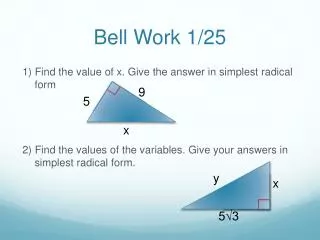
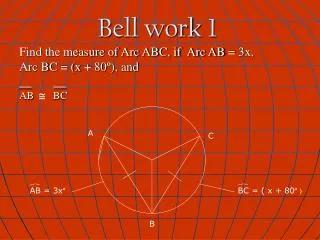
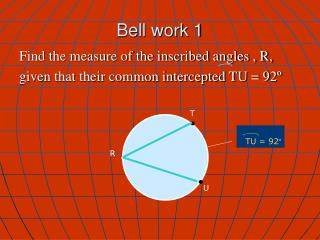
Bell work 1 Find the measure of the inscribed angles , R, given that their common intercepted TU = 92º T • TU = 92º R • • U
Bell work 1 Answer Angles R = ½ the intercepted arc TU since their intercepted Arc TU = 92º, then Angle R = 46º T • TU = 92º R • • U
Bell work 2 A quadrilateral WXYZ is inscribed in circle P, if ∕_ X = 130º and ∕_ Y = 106º , Find the measures of ∕_ W = ? and ∕_ Z = ? The Quadrilateral WXYZ is inscribed in the circle iff / X + / Z = 180º, and / W + / Y = 180º X Y • • • 130º 106º P • W • Z
Bellwork 2 Answer From Theorem 10.11 ∕_ W = 180º – 106º = 74º and ∕_ Z = 180º – 130º = 50º The Quadrilteral WXYZ is inscribed in the circle iff / X + / Z = 180º, and / W + / Y = 180º X Y • • • 130º 106º P • W • Z
Unit 3 : Circles: 10.4 Other Angle Relationships in Circles Objectives: Students will: 1. Use angles formed by tangents and chords to solve problems related to circles 2. Use angles formed by lines intersecting on the interior or exterior of a circle to solve problems related to circles
(p. 621) Theorem 10.12 If a tangent and a chord intersect at a point on a circle, then the measure of each angle formed is ½ the measure of its intercepted arc A • m∕_ 1 = ½ m minor AC P m∕_ 2 = ½ m Major ABC B Angle 1 • • Angle 2 • C m
(p. 621) Theorem 10.12 Example 1 Find the measure of Angle 1 and Angle 2, if the measure of the minor Arc AC is 130º A • m minor AC = 130º P B • • Angle 1 Angle 2 • C m
(p. 621) Theorem 10.12 Example 1 Answer The measure of Angle 1 = 65º and Angle 2 = 115º A • m minor AC = 130º P B • • 65º = Angle 1 Angle 2 = 115º • C m
(p. 621) Theorem 10.12 Example 2 Find the measure of Angle 1, if Angle 1 = 6xº, and the measure of the minor Arc AC is (10x + 16)º m minor AC = (10x + 16)º A • Angle 1= 6xº P • • C • B m
(p. 621) Theorem 10.12 Example 2 Answer Angle 1 = 6xº = ½ Arc AC = ½ (10x + 16)º 6xº = ½ (10x + 16)º 6xº = 5x + 8 x = 8º thus, Angle 1 = 48º A • m minor AC = (10x + 16)º P • • Angle 1= 6xº C • B m
Intersections of lines with respect to a circle There are three places two lines can intersect with respect to a circle. • • • Outside the cirlce On the circle In the circle
(p. 622) Theorem 10.13 If two chords intersect in the interior of a circle , then the measure of each angle is ½ the sum of the measures of the arcs intercepted by the angle and its vertical angle. D Angle 1 m∕_ 1 = ½ (m AB + m CD) • C • P • Angle 2 • A m∕_ 2 = ½ (mBC + mAD) • B
(p. 622) Theorem 10.13Example Find the value of x. m CD = 16º D • C • P • Angle 1 xº • A • m AB = 40º B
(p. 622) Theorem 10.13Example Answer x = ½ (m AB + m CD) = ½ (40º + 16º) x = ½ (56º) x = 28 º m CD = 16º D • C • P • Angle 1 xº • A • m AB = 40º B
(p. 622) Theorem 10.14 If a tangent and a secant, two tangents, or two secants intersect in the exterior of a circle, then the measure of the angle formed is ½ the difference of the intercepted arcs. 1 Tangent and 1 Secant 2 Tangents 2 Secants P X B • • • W A • • • 2 • • 3 1 • • Q • Z • • R Y C • m∕_ 1 = ½ (m BC – m AC) m∕_ 2 = ½ (m PQR – m PR) m∕_ 3 = ½ (m XY – m WZ) B
(p. 622) Theorem 10.14Example 1 Find the value of x P • • Major Arc PQR = 266º xº • Q • R m∕_ x = ½ (m PQR - mPR)
(p. 622) Theorem 10.14Example 1 Answer m PR = (360º - m PQR) = (360º - 266º) = 94º x = ½ (m PQR - m PR) = ½ (266º - 94º) = ½ (172º) x = 86 º P • • Major Arc PQR = 266º xº • Q • R m∕_ x = ½ (m PQR - mPR)
(p. 622) Theorem 10.14Example 2 Find the value of x, GF. The m EDG = 210º The m angle EHG = 68º E • F Major Arc EDG = 210º • D • • xº 68º H • G m∕_ EHG = 68º = ½ (m EDG – m GF)
(p. 622) Theorem 10.14Example 2 Answer m∕_ EHG = 68º = ½ (m EDG – m GF) 68º = ½ ( 210º - xº ) 136º = 210º - xº xº = 210º - 136º xº = 74º E • F Major Arc EDG = 210º • D • • xº 68º H • G m∕_ EHG = 68º = ½ (m EDG – m GF)
Home work PWS 10.4 A P. 624 (8 -34) even
Journal Write two things about “the intersections of chords, secants, and/or tangents” related to circles from this lesson.