Measuring Quality in Software Industry
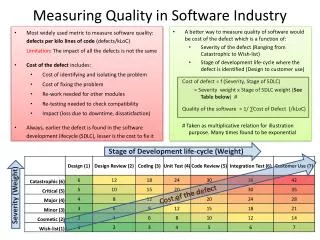
Measuring quality in the software industry often relies on the metric of defects per thousand lines of code (defects/kLoC). However, this metric has its limitations, as the impact of defects varies significantly. Costs associated with defects include identification, fixing, rework, and re-testing, alongside longer-term impacts like downtime and user dissatisfaction. Early detection in the SDLC minimizes these costs. A more comprehensive quality measurement considers defect severity and the development stage, using a cost-of-defect model that reflects these variables.

Measuring Quality in Software Industry
E N D
Presentation Transcript
Measuring Quality in Software Industry • Most widely used metric to measure software quality: defects per kilo lines of code (defects/kLoC) • Limitation: The impact of all the defects is not the same • Cost of the defect includes: • Cost of identifying and isolating the problem • Cost of fixing the problem • Re-work needed for other modules • Re-testing needed to check compatibility • Impact (loss due to downtime, dissatisfaction) • Always, earlier the defect is found in the software development lifecycle (SDLC), lesser is the cost to fix it • A better way to measure quality of software would be cost of the defect which is a function of: • Severity of the defect (Ranging from Catastrophic to Wish-list) • Stage of development life-cycle where the defect is identified (Design to customer use) • Cost of defect = f (Severity, Stage of SDLC) • = Severity weight x Stage of SDLC weight (See Table below) # • Quality of the software = 1/ ∑Cost of Defect (/kLoC) • # Taken as multiplicative relation for illustration purpose. Many times found to be exponential Stage of Development life-cycle (Weight) Cost of the defect Severity (Weight)