RECONSTRUCTION
The Reconstruction era (1865-1877) was a complex period in American history, marked by devastation and political turmoil in the South following the Civil War. Key issues included the process of readmission for Southern states, the reintegration of former Confederates, and the diverse interests of various groups including the Southern aristocracy, freed slaves, and newcomers like carpetbaggers. Important developments included the Civil Rights Acts, amendments, and the establishment of the Freedman’s Bureau. Despite achievements, the rise of Jim Crow and the end of Reconstruction in 1877 had lasting negative effects.

RECONSTRUCTION
E N D
Presentation Transcript
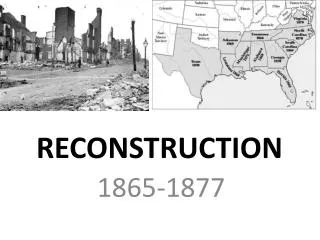
RECONSTRUCTION 1865-1877
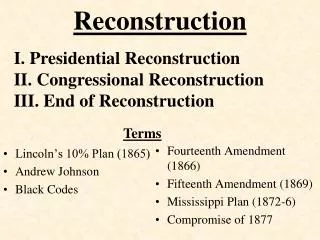
I. The State of the Union A. Conditions in the South 1. Devastation 2. Disorganization 3. Discrimination
B. Political Rivals with two questions to answer: - what is the process for readmission? - how should we reorganize Southern life? 1. Andrew Johnson 2. Radical Republicans 3. Former Confederates
C. Diverse groups with Divergent Interests 1. Southern aristocracy 2. Poor whites 3. Freed slaves 4. Carpetbaggers 5. ‘Scalawags’ 6. KKK, etc.
II. Rebuilding/Reconstructing A. Politically 1. Congressional Lock-out 2. Civil Rights Act, 1866 3. 13thamendment, 1865 4. 14th Amendment, 1867 5. 15th Amendment, 1870
B. Socially 1. Freedman’s Bureau 2. Public Schools 3. Church-based schools and universities 4. Enforcement Acts of 1870, 1871
C. Economically 1. Federally sponsored public works projects 2. Private Property rights trump redistribution 3. Sharecropping and tenant farming 4. Diversified economy
III. The End of an Era A. Jim Crow emerges B. Amnesty Act and Expiration of Freedman’s Bureau, 1872 C. Election of 1876/Compromise of 1876 1. Hayes-Tilden Deal D. Reconstruction Ends, 1877 E. Effects 1. Positive 2. Negative