Understanding Spin Precession in Neutron Interferometry
This article explores the concept of spin precession within the framework of neutron interferometry. It discusses the Hamiltonian for spin, describing how the spin interacts with magnetic fields and how this leads to precession dynamics. We examine the specifics of Bragg diffraction in silicon crystals, the role of gyromagnetic ratios, and the significance of the observed precession frequency. Notably, the relationship between magnetic field strength and rotation periods is highlighted, showcasing experimental results and the intricacies of quantum mechanics at play.

Understanding Spin Precession in Neutron Interferometry
E N D
Presentation Transcript
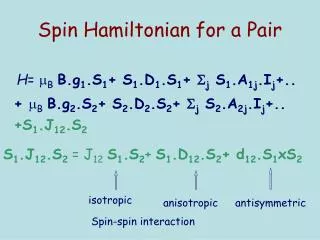
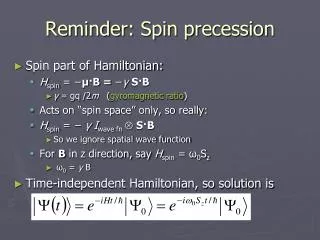
Reminder: Spin precession • Spin part of Hamiltonian: • Hspin = −µ·B = −γS·B • γ = gq/2m (gyromagnetic ratio) • Acts on “spin space” only, so really: • Hspin = − γIwave fn S·B • So we ignore spatial wave function • For B in z direction, say Hspin = ω0Sz • ω0 = γ B • Time-independent Hamiltonian, so solution is
Matrix Representation • If starting state is spin-left, i.e. • a0 = b0 = 1/√2, • then we get precession with period 2π/ω0: • NB after one period, overall sign reversed.
Beam split by Bragg diffraction in vertical crystal planes Whole interferometer carved from a perfect crystal of silicon: Separation between elements exact multiple of inter-atomic spacing. Only ~ a dozen successfully made in 30 years! Neutron interferometry ATOMINSTITUT Vienna Credit: NIST, Boulder, Colorado
g factor of neutron = −3.83 i.e. = ge/2mn even though no net charge! Precession frequency ω0=−geB/2mn de Broglie λ = 0.1445 nm Effective ℓ ≈ 2.7 cm allowing for leakage of B outside magnet. Time in field t = ℓ/v = ℓmnλ/h Angle precessed: ω0t = −geBλℓ/2h For 2π rotation we need B = 3.4 mT = 34 gauss Observed period ≈ 62 G 4π rotation needed to restore original state: 2π rotation changes sign, as predicted by QM. 2π rotation (Warner et al 1975)