Download
1 / 21
210 likes | 338 Vues
This journal explores the fundamental concepts of macromolecules and biomolecules, focusing on carbohydrates, proteins, lipids, and nucleic acids. It details the roles of monomers and polymers, highlighting the processes of dehydration synthesis and hydrolysis. Carbohydrates' classifications, protein functions, and the structure and significance of DNA and RNA are examined. Additionally, common types of saccharides, lipid characteristics, and the importance of proteins are discussed, providing a comprehensive overview of these essential organic compounds.

E N D
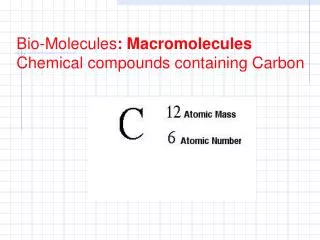
Bio-Molecules: MacromoleculesChemical compounds containing Carbon
Journal Week 4: Tuesday 9/18 • Describe what Macromolecules and Biomolecules are from using the root words you learned.
Bio-Molecules • Carbohydrates (sugars) • Proteins (made of amino acids)
Bio-Molecules • Lipids(fats) • Nucleic Acids (DNA & RNA)
Polymerization • The construction of larger compounds by joining (bonding) smaller compounds together. • Monomers=smaller compounds • Polymers=collection of smaller compounds.
How Organic Compounds are Formed and Destroyed • Dehydration Synthesis • Hydrolysis
Dehydration Synthesis • The combination of two monomers (building blocks) using enzymes and losing water.
Hydrolysis • The process of breaking down a polymer (large organic molecule) into its sub units using enzymes and water.
Carbohydrates(Sugars) • Organic compounds with a 2:1 ratio between Hydrogen and Oxygen. (CH2O) • Monosaccharides (simple sugars) C6H12O6 glucose, fructose, galactose, deoxyribose, and ribose sugar • Disaccharides (double sugars) C12H22O11 sucrose, lactose, maltose. • Polysaccharides (complex sugars) (C6H10O5)n starch, cellulose ,and glycogen
Carbohydrate Functions • Quick energy foods (glucose, sucrose, and fructose.) • Used by cells to store and release energy. • Storage=polysaccharides (starch, glycogen) • Structure (cellulose)
Lipids • A group of compounds that contain very little oxygen and are insoluble in water. • Examples: Fats, Steroids, Cholesterol, and Wax. • They are found surrounding internal organs, in each cell membrane, and clogging arteries and veins.
Saturated: No double bonds between the carbons Solid at room temperature Found mostly in animals. Unsaturated: Double bonds between some of the carbons Liquid at room temperature Found mostly in plants Main Types of Fats
Lipid Functions • High Energy food, more for long term energy. More energy than carbs! • Protects vital organs • Insulates the body • Stores food for later use
Week 4: Wednesday • Explain what the difference is between a monomer and a polymer. • Using carbohydrates as an example, give the monomer and polymer for this macromolecule
Protein • Proteins are organic compounds made up of smaller units called amino acids. • Approximately 20 known amino acids. • Each amino acid contains an NH2 or amino group and a CO2H or carboxyl group • Di/Poly Peptide Bonds
Protein Functions • Movement: Makes up muscle tissue • Transport: Carries oxygen in organisms (hemoglobin). • Immunity: Helps fight off foreign invaders (antibodies). • Enzymes: Speed up chemical reactions (amylase) • Are catalysts. Not used up. • Energy source • Cell movement
Nucleic Acids • These are chemical compounds made up of smaller units called nucleotides. • Examples are: DNA (Deoxyribonucleic acid) and RNA (Ribonucleic acid).
DNA Double Helix ( twisted ladder) Contains the bases A, T, C, & G Contains the code for the bodies proteins RNA Single strand Contains the bases A, U, C, & G Carries the code for a protein, and transfers amino acids to the ribosomes. Nucleic Acid Comparison
Clicker Quiz • 1) Which of the following correctly lists the traits of DNA and RNA? • A) DNA: Single stranded, ATCG • B) RNA: Single stranded, ATGC • C) DNA: Double stranded, ATCG • D) RNA: Single Stranded, ATGC • 2) Which of the following is not a function of lipids? • A) Long term energy storage • B) Insulates Body • C) Protects Organs • D) Low Energy Food Source • 3) Dehydration synthesis: • A) Creates polymers by removing a water molecule • B) Creates monomers by adding a water molecule • C) Creates Monomers by adding a water molecule
Clicker Quiz Cont. • 4) Hydrolysis: • A) Breaks down polymers by removing a water molecule • B) Breaks down monomers by removing a water molecule • C) Breaks down monomers by adding a water molecule • D) Breaks down polymers by adding a water molecule • 5) Which of the following is not a chemical sugar compound? • A) C6H12O6 • B) C12H22O12 • C) C12H22011 • D) CH20