Evaluation of HAWK Signal Effectiveness at 41st Ave & Burnside St in Portland, OR
270 likes | 397 Vues
This report evaluates the effectiveness of High-Intensity Activated CrossWALK (HAWK) signals at the intersection of 41st Avenue and East Burnside Street in Portland, Oregon. It analyzes area characteristics, data from pedestrian and bicycle counts, and violation statistics to assess the impact of HAWK signals on pedestrian safety. Recommendations for signal improvements and public education are provided, alongside acknowledgments to contributors. The study aims to enhance safety for cyclists and pedestrians while addressing crash patterns and compliance rates.


Evaluation of HAWK Signal Effectiveness at 41st Ave & Burnside St in Portland, OR
E N D
Presentation Transcript
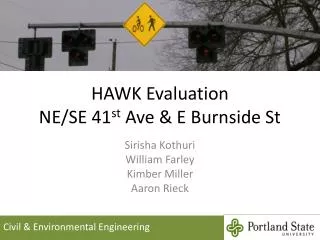
HAWK EvaluationNE/SE 41st Ave & E Burnside St Sirisha Kothuri William Farley Kimber Miller Aaron Rieck Civil & Environmental Engineering
Outline • Introduction • Area Characteristics • Data • Analysis • Conclusions • Recommendations • Acknowledgements Civil & Environmental Engineering
Introduction • High Intensity Activated CrossWalK • Motivation • Portland Crashes (1985 – 2002) • Increase in bicycle traffic • Commitment to walking and biking Pedestrians Crashes 3% Injuries 29 % Fatalities Civil & Environmental Engineering
Introduction – cont. • Crashes at non – signalized intersections • Bikes and Peds have trouble finding gaps • Motorists on major streets do not yield or stop • Options to reduce crashes • Median refuge islands, painted crosswalks • Low compliance rate • Install traffic signal • Not warranted, higher delay, increase in emissions • HAWK Civil & Environmental Engineering
MUTCD & HAWK Locations • 2009 MUTCD • Includes information on ped hybrid beacon • Application, design and operation • Installed locations • Portland, OR • 41st & Burnside • 18th & Sandy • Tucson, AZ • Other cities (Washington DC, Salt Lake City ) Civil & Environmental Engineering
Study Area Burnside St & 41st Ave Civil & Environmental Engineering
Study Area E. Burnside St & 41st Ave Current Portland Bicycle Map Portland Bicycle Plan for 2030 Civil & Environmental Engineering
Study Area - 41st Avenue Civil & Environmental Engineering
Study Area - Burnside St Civil & Environmental Engineering
Study Area – Intersection Diagram Study Area Source: FHWA Experimentation #4-298(E) Modified HAWK Signal and Bike Signal - Draft Report Civil & Environmental Engineering
HAWK Westbound Burnside Eastbound Burnside Civil & Environmental Engineering
HAWK Display Flashing Yellow Solid Yellow Solid Red Flashing Red Civil & Environmental Engineering
Bike and Pedestrian Displays Don’t Walk Walk Flashing Don’t Walk Civil & Environmental Engineering
Display Sequence Source: FHWA Experimentation #4-298(E) Modified HAWK Signal and Bike Signal - Draft Report Civil & Environmental Engineering
Data • Video data available for 4 days in May 2009 • Analyzed time periods • PM Peak (5 – 6 PM) on Thursday, 5/14/2009 • AM Peak (8 – 9 AM) on Friday, 5/15/2009 • Type of data gathered • Counts: Pedestrian & Bicyclist • Violations: Pedestrian, Bicyclist, & Motor vehicles • Delay: Pedestrian & Bicyclist Civil & Environmental Engineering
Intersection via Video Civil & Environmental Engineering
Analysis – Pedestrian & Bicycle Delay • Delay data not collected from video because of camera angle • HAWK activates as soon as button is pressed • Min time between activations – 30 sec • Observed and collected data in PM on February 22, 2011 Civil & Environmental Engineering
Analysis – Pedestrian Counts Civil & Environmental Engineering
Analysis – Pedestrian Violations Total AM => 23 Total PM => 24 Civil & Environmental Engineering
Analysis - Bicycle Counts Civil & Environmental Engineering
Analysis – Bicycle Violations Total AM => 44 Total PM => 84 Civil & Environmental Engineering
Analysis – Vehicle Movement Violations Counts Civil & Environmental Engineering
Analysis – Vehicle Violation Specifics HAWK Activations AM => 28 PM => 41 Civil & Environmental Engineering
Crashes Source: FHWA Experimentation #4-298(E) Modified HAWK Signal and Bike Signal -Draft Report Source: FHWA “Safety Effectiveness of the HAWK Pedestrian Crossing Treatment” .. Civil & Environmental Engineering
Conclusions • Primary objective of using the HAWK system • System usage at study location • Violations were observed for all modes • Crashes for the study location Civil & Environmental Engineering
Recommendations • Improvements to the signal on Burnside • Improvements to the signal on 41st • Increased public education • Further research on crash patterns and effectiveness Civil & Environmental Engineering
Acknowledgements • Bureau of Transportation, City of Portland • Dr. Ashley Haire, Portland State University • Mark Haines, PSU/City of Portland Civil & Environmental Engineering