Download
1 / 12
120 likes | 225 Vues
This work focuses on improving distance queries, which return the minimum distance between two geometric models, essential in path planning. Hierarchical methods often consume 90% of execution time on these queries. By utilizing hybrid bounding volumes (BVs), we streamline the process of finding the closest pair of triangles in polygonal models. Our approach uses simpler BVs that can effectively prune searches while minimizing computational costs. We also identify scenarios where certain BVs may not be optimal, laying groundwork for future improvements and optimizations.

E N D
Hybrid Bounding Volumes for Distance Queries • Distance Query returns the minimum distance between two geometric models • Major application is path planning - in some methods, 90% of execution time spent in distance queries
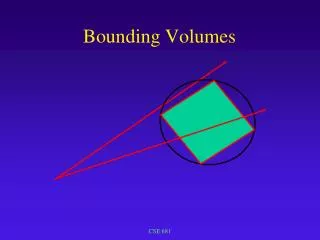
Hierarchical Method • With polygonal models, must find pair of triangles with minimum distance • Bounding volumes accelerate this task: • when distance between tris computed, minimum is adjusted • if a pair of BV’s are farther apart than current minimum, the triangles they contain cannot achieve a minimum.
Use of BV’s current minimum Can reject all pairs within the BV’s
Hybrid BV’s • Use a simpler BV when it prunes search equally well - benefit from lower cost of BV distance computation. • Complications: • deciding which BV to use - dynamically or statically • optimizing distance computation between all pairs of BV’s in tree.
Benchmarks Small torus passes through center of large torus
Benchmarks Small torus passes through center of very large torus
Contributions • A class of shapes which might have good properties for hybrid hierarchies. • Distance algorithm for a pair of rectangles.
Future work • Characterize situations where RSS’s are not the optimal BV type for distance. • Determine how to detect these situations so that other BV’s can be used.