Design Concept for Chicane and Absorber with Vertical Dispersion in Beam Dynamics
This document outlines the design concept of a chicane and absorber configuration intended to manage beam dynamics effectively. The system incorporates a bent solenoid chicane to induce vertical dispersion in a proton beam, ensuring high-momentum particles exit while low-momentum protons are absorbed. The study presents detailed equations of motion, motion characteristics, and particle behavior before and after passing through the chicane and absorber. It emphasizes the operational parameters and performance analyses, aiming for minimal disruption to the central beam while optimizing particle handling.

Design Concept for Chicane and Absorber with Vertical Dispersion in Beam Dynamics
E N D
Presentation Transcript
Chicane Beam Dynamics David Neuffer August 2012
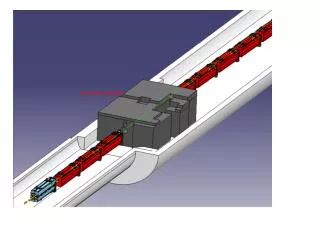
Chicane/Absorber Design Concept Bent solenoid chicane induces vertical dispersion in beam bend out – 5m, 12.5° Single chicane will contain both signs Opposite signs have dispersion in opposite sense Little disruption to the central beam High momentum particles scrape Subsequent proton absorber to remove low momentum protons Non-relativistic protons don't have much energy, even for relatively large momenta (~10cm Be) p-, m- p+, m+ proton absorber bend back p, p-, m- p+, m+ bend out field taper target station
Front End with Absorber-Rematch p π →μ FE Target Drift Solenoid Buncher Rotator Cooler 10.1 m 0.1 m Be ~39.5m ~33m 18.9 m 42 m ~80 m • with absorber • particle 1-270 MeV/c • particle 2-185 MeV/c • absorber at 29m • 10cm Be • particle 1-237 MeV/c • particle 2-144 MeV/c • Bunch N=10 • Rotate N=10.04 • Cool -201.25MHz • pref=230 MeV/c
Add chicane to absorber • ICOOL version • 2 Bent Solenoids – 10m • 5m, 1.5T, 12.5º,0.27GeV/c • 5m, 1.5T, -12.5º ,0.27GeV/c • bend radius is 22.92m (1/r=0.043636) • By=0 • Match to channel • add 1m drift • ICOOL BSOL element: p-, m- p+, m+ proton absorber bend back p, p-, m- p+, m+ bend out SREGION ! bentsol 5.0 1 1e-2 1 0. 1.0 BSOL 1 1.5 0.0 1 0.27 0.0 0.043636 0.0 0.0 0.0 0. 0. 0. 0. 0. VAC NONE 0. 0. 0. 0. 0. 0. 0. 0. 0. 0. field taper target station
Equations of motion and solution • Equations of motion: • b= Bo /Bρ and h=1/R; R= 22.918m, B0=1.5T ,Bρ (T-m) = p (GeV/c)/0.3 • C1=y(0), C2=y’(0), C3=x(0), C4= x’(0) ; s<5m • , p-, m- p+, m+ proton absorber bend back p, p-, m- p+, m+ bend out field taper target station 5<s+s0<10m; s0=5m
reference particles in chicane • x deviation • p=0.2, 0.3, 0.4, 0.5, 0.6, 0.7,0.8 ,0.9 • y deviation • p=0.2, 0.3, 0.4, 0.5, 0.6, 0.7, 0.8, 0.9
More reference particles • x motion • p=0.05, 0.1, 0.15, 0.2, 0.25, 0.3, 0.35 ,0.4 • y motion • p=0.05, 0.1, 0.15, 0.2, 0.25, 0.3, 0.35 ,0.4
motion within chicane • vertical dispersion • D=-h p s /(0.3B0) • s<s0 • D=h p (s-s0) /(0.3B0) • s0<s<2s0 • oscillatory motion • period is Λ= 2π p/(0.3B0) • initial amplitude is • A=hp2/(0.3B0)2
Chicane + absorber • Chicane effect: • P > ~500MeV/c are lost • P < ~500MeV pass through • displaced by ~1.1m • Nominal Path length increased by only 8cm • orbits perturbed • absorber effect • removes low energy particles • designed to remove protons • distorts energy distribution • energy phase-rotation distorted; must be rematched
Compare-absorber vsabsorber+chicane This compares absorber only (10cm Be) to chicane (BSOL) + absorber 1.0 GeV/c z=38m z=38m 0 z=137m z=137m z=255m z=255m