Enhancing Teacher Education Through Professional Development Schools at Winthrop University
Since 1993, Winthrop University has actively engaged in establishing Professional Development Schools (PDS) across 15 schools in 4 counties and 7 districts. These partnerships aim to prepare future teachers, conduct research on best practices, and enhance professional development while improving P-12 student learning. Through the support of the National Network for Educational Renewal and the South Carolina Network for Educational Renewal, we focus on accountability, collaboration, and diversity. Join us in shaping effective educators and creating meaningful educational experiences.

Enhancing Teacher Education Through Professional Development Schools at Winthrop University
E N D
Presentation Transcript
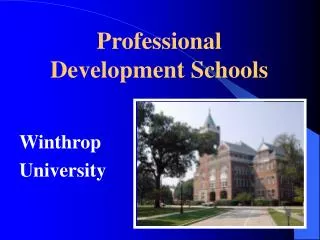
Professional Development Schools Winthrop University
Since 1993… • 15 PDSs • 4 Counties • 7 School Districts
Twenty School-University Partnerships(43 colleges and universities and more than 600 public schools in over 100 school districts) 20
The South Carolina Network for Educational Renewal:Benedict CollegeColumbia CollegeFurman UniversityUniversity of South Carolina-ColumbiaWinthrop University(and their partner P-12 schools)
Purposes • Prepare teachers • Conduct inquiry about best practice • Provide opportunities for professional development • Improve P-12 learning
2002 Professional Development Schools • Cotton Belt Elementary School • Crowders Creek Complex • Lancaster High School • Lewisville Elementary School • Riverview Elementary School • Sullivan Middle School
PDS National Recognition2001-2002 • NNER Conference Denver, CO • PDS Conferences Orlando, FL Baltimore, MD • AERA New Orleans, LA Chicago, IL
Early Questions • What are critical attributes of a professional development school? • How do we start and implement partnership activities?
Current Concerns • Do professional development schools make a difference? • How?
Lee Teitel’s Review of Research • Collect baseline data. • Weave assessments into use of NCATE’s PDS standards. • Report results to the PDS community and its various stakeholders.
NCATE PDS Standards • Based on 18 PDS pilot sites • Field-tested for 3 years • Revision published in February 2001 • Optional accrediting process
I. Learning Community • Inquiry-based • Extended learning community • Arts and Sciences, family, community
II. Accountability and Quality Assurance • Assessment, evaluation, reflection, action • Public evidence • Strategies for engaging others
III. Collaboration • Blurred boundaries • Shared decision-making • Parity • Celebrations
IV. Diversity and Equity • Address gaps in achievement • Multicultural, global perspectives • Diverse faculty
V. Structures, Resources, Roles • Governance—Arts and Sciences, family, community • Reward system • Budget lines • Communication links
Developmental Levels of PDSs • Beginning • Developing • At Standard • Leading
Self-assessment by school “Backwards mapping” “PRE” and “NOW” Establish a baseline. Plan assessment system for 3rd generation of PDSs. Use of NCATE PDS Standards
Develop a PDS Portfolio • Ideal • Showcase • Documentation • Evaluation • Class (Gredler, 1995)
Evaluation Portfolio • Provides standardized reporting format. • Priorities are pre-established. • Evaluation criteria are pre-determined.
Plans for the Future • Provide more assistance with portfolio development. • Conduct program evaluation. • Share data with constituencies.
“It takes a whole village to raise a partnership.” The PDS Family
Developed by: Jonatha Vare, Director, Center for Pedagogy Matt Brown, Principal, Cotton Belt Elementary Paulette Moore, Teacher, Cotton Belt Elementary Crystal Small, Graduate Assistant, Center for Pedagogy