Human Heredity
This overview of human heredity explains the role of chromosomes in determining traits. It details the distinction between autosomal and sex chromosomes, highlighting how traits are influenced by genetic inheritance. The probabilities of having male or female offspring are discussed, along with examples of sex-linked traits like colorblindness and hemophilia. Several genetic disorders, including cystic fibrosis and sickle cell anemia, are also examined, along with their causes and impacts. This valuable information on genetics aids in understanding how traits are passed down through generations.

Human Heredity
E N D
Presentation Transcript
There are 44 chromosomes that we call autosomal chromosomes. • However, there are 2 chromosomes that determine our sex and we call them sex chromosomes. • These 46 chromosomes all carry genes on them that determine our traits.
Out of our 23 pairs of chromosomes, 1 pair is the sex chromosomes (X and Y). • Female = XX • Male = XY
Question? If my parents have 5 boys in a row, what is the chance they will have a girl the next time? 50%
Question: What is the probability that your parents will have a boy or girl? • XY (dad) x XX (mom) Y X Phenotype: 50% boy 50% girl X XX XY Genotype: 50% XX 50% XY X XX XY
Sex-linked gene: • Some traits are carried on the sex chromosomes. Genes on the X or Y chromosomes are sex-linked genes. • These traits are passed on from parent to child. Sex- linked genes can be recessive or dominant. • MALES are more likely to have a sex-linked trait because they only have ONE X and Y. The allele is USUALLY on the X chromosome. • Ex. colorblindness, hemophilia, hairy ears, muscular dystrophy
Carrier – person who has one recessive allele and one dominant allele for a trait or heterozygous for that trait (only women can be carriers). Example Hemophiliac carrier XHXh Colorblind carrier XBXb
Sex linked Punnett Squares: Question: What is the probability that a carrier female and a colorblind male will have a girl who is colorblind (b = colorblind, B = normal)? Xb Y Phenotype: 25% normal boy 25% colorblind boy 25% normal girl 25% colorblind girl XBXb XBY XB Xb XbXb XbY
Try this one on your own Question: What is the probability that a homozygous (normal vision) female and a colorblind male will have a girl who is colorblind (b = colorblind, B = normal)?
Parents: XBXB x XbY Xb Y Phenotype: 50% normal girls 50% normal boys XBXb XBY XB XB XBXb XBY
Mutations … • are changes in the genetic material • can be good or bad • can be on a single gene or the whole chromosome
Genetic Disorder – abnormal condition that a person inherits through genes or chromosomes. They are caused by mutations or changes in a person’s DNA. Write down 3 disorders that have affected someone you know.
Cystic Fibrosis • Genetic disorder where the body produces abnormally thick mucus in the lungs and intestines making respiration and digestion difficult • caused by a mutation in a gene. The product of this gene is a chloride ion channel important in creating sweat, digestive juices and mucus. • One in four babies are born with cystic fibrosis • Most common among Northern European descent
Sickle Cell Anemia • Sickle cell is a genetic disorder that affects the blood’s hemoglobin. Hemoglobin is the protein in your blood that carries oxygen. • Sickle-cell anemia is caused by a point mutation in protein chain of hemoglobin, replacing the amino acid glutamic acid with the amino acid valine • The ‘sickle shape’ of the cell doesn’t allow the red blood cell to carry very much oxygen. • Most common among African American descent Famous People with Sickle Cell Disease Miles Davis, jazz musician. Paul Williams, singer (The Temptations) Georgeanna Tillman, singer (The Marvelettes) Tionne "T-Boz" Watkins, singer (TLC)
Hemophilia • Hemophilia is a genetic disorder in which a person’s blood clots VERY slowly or not at all. • A person with hemophilia can bleed to death from a paper cut or scrape. • This is sex-linked disorder on the X chromosome. • Queen Elizabeth suffered from this disorder. This man received a vaccine. This is what having hemophilia did to is body.
Down Syndrome • Down Syndrome is a genetic disorder that occurs when an individual receives an extra copy of a chromosome. • A mistake occurs during Meiosis I: the chromosomes failed to separate correctly (non-disjunction) therefore leaving an extra copy of chromosome #21.
Doctor’s use tools like amniocentesis and karyotypes to helpdetect most diseases.
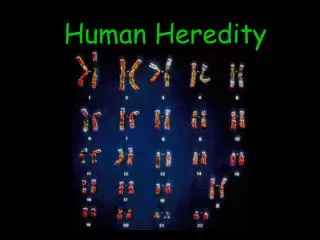
What is a karyotype? • Picture of your chromosomes • Arranged from largest to smallest • quickly identify chromosomal changes
Sex-linked-Practice on your own: • What is the probability of a female carrier of hemophilia and a normal male having a boy with hemophilia? • What is the probability of a man with hairy ears and a normal female (not a carrier) having a child with hairy ears? • What is the probability of a carrier woman and a male with muscular dystrophy having a girl with muscular dystrophy?