Understanding Oceanic Crust and Plate Tectonics: Key Concepts in Earth Science
This review covers essential concepts of plate tectonics, focusing on oceanic crust characteristics and the historical context of Alfred Wegener's theory of continental drift. It discusses the evidence for plate tectonics, including the formation of supercontinents like Pangaea, the mapping of mid-ocean ridges, and the effects of tectonic plate interactions such as subduction and sea floor spreading. The content also highlights the significance of convection currents in the mantle and the geological structures formed at tectonic boundaries.

Understanding Oceanic Crust and Plate Tectonics: Key Concepts in Earth Science
E N D
Presentation Transcript
Mr. Murray’s Clicker Review Ch. 4 Plate Tectonics
OLD OCEANIC CRUST IS . . . • WARMER, MORE DENSE • COOLER, MORE DENSE • WARMER, LESS DENSE • COOLER, LESS DENSE
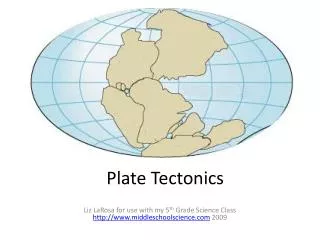
Wegener believed all the landmasses formed one supercontinent called • Panthalassa • Laurasia • Gondwanaland • Pangaea
These can be body parts, traces of where an organism lives or the actual organism trapped in ice, tar or amber • Fossils • Landmasses • Climate evidence • Mesosauris
Alfred Wegener had lots of evidence for his theory of _____________ • Sea floor spreading • Plate Tectonics • Subduction at deep ocean trenches • Continental drift
Why was wegener’s theory not accepted? • He didn’t have enough evidence • He didn’t know about the lithosphere and asthenosphere • Gravity had not been discovered yet. • No one knew about convection currents in the mantle
Which was not part of wegener’s evidence? • Continents fit together like jigsaw puzzles. • Mid ocean ridges and magnetic stripes • Fossils of plants and reptiles on several continents • Land features such as coal mines, glaciers and mountains
How was the mid ocean ridge mapped? • Radar • Submarines • Sonar • Deep sea diving
In _______________ molten material rises from the __________ and erupts along __________________ • Subduction, lithosphere, deep ocean trenches • Subduction, mid ocean ridge, deep ocean trenches • Sea floor spreading, inner core, divergent boundaries • Sea floor spreading, mantle, mid ocean ridges
Convection currents in the mantle cause all of the following except. . . • Magnetic reversals • Plate movement • Pillow lava formed at mid ocean ridges • Volcanoes formed at deep ocean trenches
A collision of two continental plates causes • Subduction of the denser plate • Sea floor spreading • Mountain ranges to form • Volcanoes to form
Collision of 2 oceanic plates cause • Subduction of the denser plate • Sea floor spreading • Mountain ranges to form • Subduction of the less dense plate
Where 2 plates meet is called a . . . • Fault • Border • Boundary • Tectonic collision
Where 2 plates are pushed together there is a . . . • A divergent boundary • A rift valley • A transform boundary • A convergent boundary
Where 2 plates are being pushed apart, there is a • Convergent boundary • Divergent boundary • Mountain formed • Transform boundary
Where 2 plates slip past each other there is • A rift valley • A mountain formed • A volcano formed • An earthquake
Rift valleys occur • At a divergent boundary between continental and oceanic crust • At a convergent boundary of continental and continental crust • At a transform boundary of continental and continental crust • At a divergent boundary of continental and continental crust
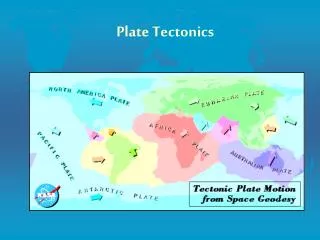
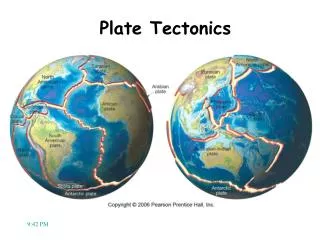
The minor plate between africa and eurasia is the _________ plate • Cocos • Phillipine • Arabian • Nazca
The minor plate that part of california and washington are on is the . . . • North American plate • Juan de Fuca plate • Pacific plate • Eurasian plate
The minor plate that is between south america and antarctica is the _____ plate • Scotia • Phillipines • Carribean • Riviera
The ring of fire is an area where there is a lot of plate boundaries that cause earthquakes and volcanoes. This ring surrounds the ___________ plate • Antarctic • Eurasia • Pacific • Indo-australian
When ____________ happens in a area at a faster rate than ____________, the plate _____________ • Sea floor spreading, subduction, shrinks • Subduction, sea floor spreading, expands • Sea floor spreading, subduction, expands • Subduction, sea floor spreading, moves
Which of these plates does not meet at the mid-atlantic ridge? • Indo-australian • South American • African • Eurasian
A continental plate collides with an oceanic plate at a ___________ boundary • Convergent • Divergent • Transform • Fault
When __________ collided with ________ the __________ mountains were formed • China, Eurasia, Indonesian • Eurasia, North America, Appalachian • Australia, Antarctica, Ganges • India, Eurasia, Himalayan
Earth’s tectonic plates are part of the _________ and float on top of the _________ • Lithosphere, Asthenosphere • Mantle, Crust • Asthenosphere, Mantle • Crust, Outer Core