Exploring the Baroque Era (1600-1750): Art, Music, and Key Figures
The Baroque Era, spanning from 1600 to 1750, is characterized by dramatic expression and intricate artistry in various fields including music, painting, and architecture. Coined from the Portuguese term for “misshapen pearl,” Baroque reflects the grandeur and emotional depth of the period. Influenced by notable figures like Monteverdi, Bernini, and Bach, it marked significant developments in compositional techniques such as counterpoint and instrumental writing. Key highlights include the emergence of opera and emotionally charged music. This era laid the foundation for contemporary musical notation.

Exploring the Baroque Era (1600-1750): Art, Music, and Key Figures
E N D
Presentation Transcript
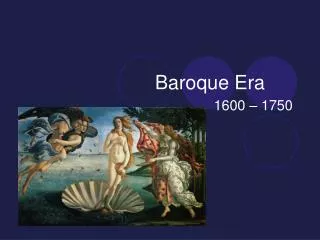
The Baroque Era 1600-1750
“Baroque” • Coined by a French Scholar, in reference to a building facade • From the Portuguese work “barrocco” (misshapen pearl), meaning “absurd” or “grotesque”
Italy • The period was heavily influenced by Italian thinking • Monteverdi, Bernini, Scarlatti, Carvaggio • Pre-risorgimento
A Period of Great Creative Output • John Milton (Paradise Lost), Isaac Newton - England • Miguel de Cervantes (Don Quixote), Velasquez – Spain • Rembrandt Van Rijn – Netherlands • Renee Descartes – France • Johannes Kepler, Gottfried Leibniz – Germany
The Musical Affections • Rage, excitement, grandeur, heroism, lofty contemplation, wonder or mystic exaltation • These emotions were meant to be represented by musical ideas • Emotion became the driving force behind composition • Codified in the “Book of Affections”
Other Baroque Era Characteristics • Idiomatic writing (writing for specific instruments) • “Terraced” dynamics • Differentiation between vocal and instrumental writing • Standardization of instrumentation
Baroque Characteristics con’t… • The Continuo – Figured Bass
Baroque Characteristics con’t… • Codification of notation • Notation the way we know it today owes its existence to the Baroque era • Pre-baroque, notation looked very different
Baroque Characteristics con’t… • Use of “counterpoint”, or “contrapuntal” composition • Melodic material that is added above or below an existing melody. • The technique of combining two or more melodic lines in such a way that they establish a harmonic relationship while retaining their linear individuality.
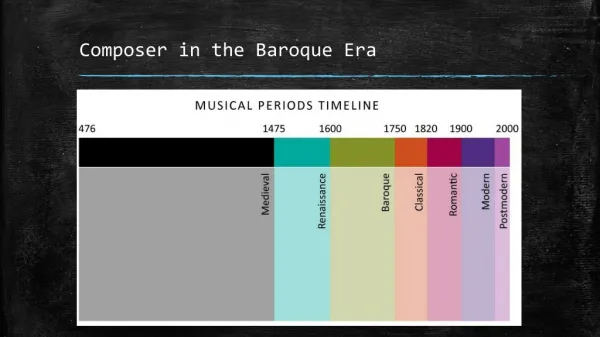
Some Baroque composers of “note” • Claudio Monteverdi (1567-1643) • Arcangelo Corelli (1653-1713) • Henry Purcell (1659-1695) • Antonio Vivaldi (1678-1714) • Georg Philipp Telemann (1681-1767) • George Frideric Handel (1685-1759) • Johann Sebastien Bach (1685-1750)
Opera • Revisitation of Ancient Greek Ideals – Staged Drama • It was argued that some of these plays involved singing • Claudio Monteverdi wrote the “first” opera in 1607 based on the Greek myth of “Orfeo and Euridice”
Next Week - Bach vs. Handel for the Baroque Heavyweight Championship