Solar System
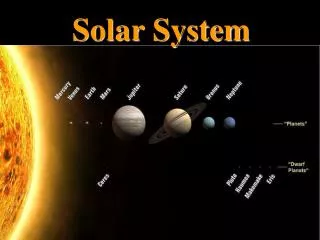
Discover fascinating facts about four intriguing celestial bodies in our solar system! Saturn, the majestic sixth planet, boasts a stunning diameter of 120,536 km and orbits the sun from a distance of 1.43 billion km. Venus, the brightest planet, has a harsh environment dominated by carbon dioxide, with days longer than its years. Neptune, named after the Roman god, has a shorter day than Earth and a unique set of 8 moons. Finally, Pluto, once considered the smallest planet, travels beyond Neptune's orbit and takes 248 Earth days to complete its journey around the sun.

Solar System
E N D
Presentation Transcript
Solar System 5th Grade 2010-2011
Saturn Saturn is the sixth planet from the sun, and the second largest planet. It orbits around the sun at 1,429,400,000 km. . The diameter of Saturn is 120,536 km. . The mass 5.68e26 kg. .
Venus The atmosphere of Venus is mostly made up of carbon dioxide. It take 225 Earth days to go around the sun. On Venus a day is long than its year. Venus is the second planet form the sun. It is the brightest planet. The length of a day at Venus is 117 earth days. Venus has no moons. There is no life an Venus because it is so hot and dry.
NEPTUNE • By: Tanner Bachman,Megan Studer, and Nicolas Owens • Neptune was the Roman Mythological God of the sea and earthquakes, he was also called the earth-shaker! • Neptune has a shorter day than Earth. One day on Neptune is 16 Earth hours • Neptune has 8 mo0ns. • Neptune is 2,829,691,160 miles from the sun.
Pluto by: Jed, Ashlyn, and Autumn! Pluto is the smallest planet. It has not been visited by a spacecraft. Some people say it is not a planet because it is so far out. Pluto journeys around the sun. It takes 248 earth days. Pluto orbits beyond the orbit of Neptune.