Download
1 / 2
20 likes | 116 Vues
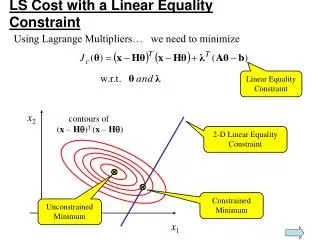
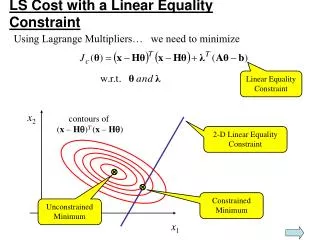
Minimize cost with linear constraint using Lagrange Multipliers. Explore x2 contours of (x – Hθ)T(x – Hθ). Understand 2D linear equality constraints for minimum and unconstrained minimum. Analyze the linear constraint ax1 + bx2 – c = 0 and its implications. Learn about constrained and unconstrained optimization, Lagrange Multipliers, and gradient vectors.

E N D
LS Cost with a Linear Equality Constraint Using Lagrange Multipliers… we need to minimize Linear Equality Constraint x2 contours of (x – H)T (x – H) 2-D Linear Equality Constraint Constrained Minimum Unconstrained Minimum x1
Ex.ax1 + bx2 – c = 0 x2 = (–a/b)x1 + c/b A Linear Constraint Ex. The grad vector has “slope” of b/a orthogonal to constraint line Constrained Max occurs when: Constrained Optimization: Lagrange Multiplier x2 f (x1,x2) contours Constraint: g(x1,x2) = C g(x1,x2) – C = h(x1,x2) = 0 x1