Download
1 / 10
100 likes | 251 Vues
Learn how to conjugate regular -ER verbs in French! This guide explains the process of dropping the -er ending and adding appropriate endings for different subjects. Understand key verbs such as "parler," "travailler," and "habiter." Additionally, discover how to handle irregular verbs like "avoir," "être," "faire," "aller," and "venir," including their meanings and uses. Practice with example sentences to reinforce your understanding and improve your French speaking skills.

E N D
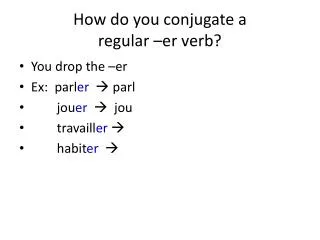
How do you conjugate a regular –er verb? • You drop the –er • Ex: parler parl • jouer jou • travailler • habiter
And add the following endings: • Je -e Nous -ons • Tu -esVous -ez • Il, elle, on -e Ils, elles -ent
Conjugate the following verbs • Nous (parler) ________________________ • Tu (travailler) ________________________ • Je (chercher) ________________________ • Vous (nager) _________________________ • Il (manger) __________________________ • Marie et toi (parler) ____________________ • Elles (penser) _________________________
There are some irregular verbs… • That means that they don’t follow a certain pattern…. • Avoir • Etre • Faire • Aller • Venir • What do they mean? When do you use them?
Avoir (to have) Used with: age, avoir expressions such as avoirfaim, avoirsoif, avoirfroid, avoirchaud, avoirpeur…. I am 15 yrs.old She is hungry
Faire(to do/to make) Used with weather expressions and with some sports expressions such as faire du tennis, faire des achats…. Its hot We go shopping
Etre (to be) We are tall. They are smart. You (familiar) are funny.
Aller (to go) Used to say 1. you are going somewhere and 2. to express the immediate future….going to + infinitive Ex: 1. Je vais au cinéma. I am going to the movies. 2. Je vais chanter dansuneheure. I am going to sing in an hour
Venir (to come) Used to say 1. to come and 2. to express the immediate past…. To have just + infinitive… Ex: 1. Je viens chez toi (I am coming to your house) 2. Je viens de finirmesdevoirs. (I have just finished my HW)
Mettez les verbessuivantsdans la formecorrecte: • 1. Nous (to go) _________________ au stade. • 2. Tu (to be) ___________________ belle. • 3. Ils (to do) ________________leurs devoirs. • 4. Je (to come) __________________chanter. • 5. Elle (to have) __________________14 ans. • 6. Marie et toi (to be) __________________ • 7. Les profs (to go) ____________________