A Comprehensive Guide to Naming Ionic Compounds
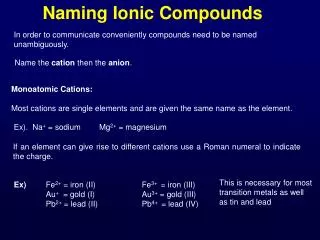
This guide provides a clear and concise method for naming ionic compounds, focusing on the systematic approach required. First, identify the cation (metal), followed by the anion (nonmetal). If the anion is a polyatomic ion, use its name directly; for single elements, change the ending to "-ide". Remember to denote oxidation states with Roman numerals for transition metals using the criss-cross method. This resource includes practical examples, such as CaCl₂ and FeCl₃, to enhance understanding of proper nomenclature in chemistry.

A Comprehensive Guide to Naming Ionic Compounds
E N D
Presentation Transcript
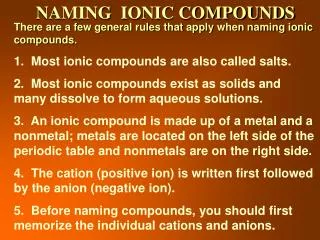
1) Name the cation (metal) This one is always first in the formula. 2) Name the anion (nonmetal) **if it is a polyatomic ion write the name **if it is a single element change ending to ide ****if it sounds awkward…it is most likely wrong.
Examples CaCl2 Mg(NO3)2
3) If the formula has a star by it, then it will have a Roman numeral. To find the Roman numeral, undo the criss-cross. Go to the end of the formula and work backwards
Examples FeCl3 Ask: where did that number, 3, come from? FeCl3 (Work backwards, uncross numbers) example: FeCl3 = Fe 3+Cl- FeCl3 is iron 3+ so the name is iron (III) chloride
Common Roman Numeral Metals • Iron • Lead • Copper • Tin • Chromium • Nickel • Mercury • Cobalt
CuNO3 Copper(I) nitrate
Worksheet Fe2S3 iron(III) sulfide
CaBr2 calcium bromide