Understanding Ionic Compounds: Transition Metals and Polyatomic Ions Naming
This guide provides a comprehensive overview of naming ionic compounds, focusing on transition metals and polyatomic ions. Key rules include using no prefixes, naming the metal first, and changing the ending of non-metals to "-ide." Transition metals can form multiple cations, which are indicated by Roman numerals. Examples illustrate how to determine charges and write chemical formulas. Additionally, the guide addresses polyatomic ions, emphasizing their unique characteristics and naming conventions. A practical handout is included for effective learning.

Understanding Ionic Compounds: Transition Metals and Polyatomic Ions Naming
E N D
Presentation Transcript
Naming Ionic Compounds Transition Metals and Polyatomic ions
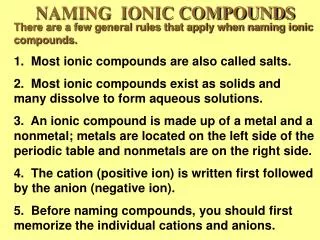
Remember: • No prefixes !!!!!! • Write the name of the metal. • Write the name of the non-metal. • Change the ending of the non-metal to “ide” Ex: NaCl sodium chloride
Transition Metals: • Nearly all the transition metals are able to form more than one cation or are multi-valent. • Ex: iron can form Fe2+ and Fe3+. Given the formula of an ionic compound you can use the reverse cross-over method to determine the charge of the cation. Ex: FeCl3
Stock System: • The charge of the cation is written in parentheses as a roman numeral. Ex: Fe3+ would be iron (III) and Fe2+ would be iron (II). • Remember roman numerals: 1-(I), 2- (II), 3-(III), 4-(IV), 5-(V).
Example: • Both CuO and Cu2O are real compounds • We know that O always has a charge of -2 • For CuO, we know that it is the Cu+2 ion (sum to zero) copper (II) oxide • And for the Cu2O, we know that there is 2 x the Cu+1 ion (to sum to zero) copper (I) oxide
Try to write names for these (don’t forget the roman numberial for the metal) : • CrO • Au3P • SnCl4
Given the name we can write the formula: • Nickel (III) bromide • We know that Br is always Br-1 • We also know that this is the Ni3+ ion (it tell us in the brackets) • Therefore we need 3 x Br-1 with Ni3+ for the compound to be neutral (sum to zero) NiBr3
Try these: • lead (II) chloride • mercury (I) arsenide • cobalt (II) chloride.
Polyatomic Ions • Have a charge ( + or - ) • Consists of two or more non-metal atoms (or metal complex) joined by a covalent bond • Act as a single unit
Write names for ionic compounds containing polyatomic ions: • Na2CO3 • KOH • Sn3(PO4)4
Writing chemical formulas for ionic compounds containing polyatomic ions: (remember to use parentheses to indicate the correct number of ions) • ammonium sulfide • lead (IV) hydrogen carbonate • calcium hydroxide • magnesium nitrate