Understanding Sentence Types: Declarative, Imperative, Interrogative, and Exclamatory
This guide explores the four fundamental types of sentences: declarative, imperative, interrogative, and exclamatory. Each type serves a unique purpose in communication, from making statements to issuing commands or asking questions. For instance, declarative sentences state facts, imperative sentences provide commands, interrogative sentences pose questions, and exclamatory sentences express strong emotion. Additionally, we analyze different sentence structures, including simple, compound, complex, and compound-complex sentences, with examples to enhance understanding.

Understanding Sentence Types: Declarative, Imperative, Interrogative, and Exclamatory
E N D
Presentation Transcript
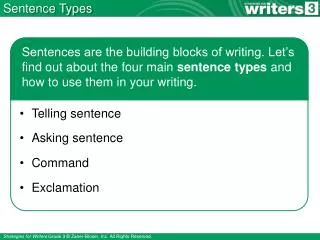
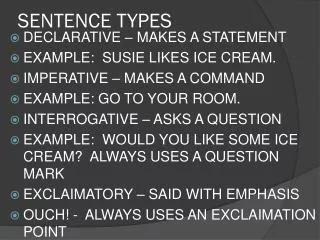
SENTENCE TYPES • DECLARATIVE – MAKES A STATEMENT • EXAMPLE: SUSIE LIKES ICE CREAM. • IMPERATIVE – MAKES A COMMAND • EXAMPLE: GO TO YOUR ROOM. • INTERROGATIVE – ASKS A QUESTION • EXAMPLE: WOULD YOU LIKE SOME ICE CREAM? ALWAYS USES A QUESTION MARK • EXCLAIMATORY – SAID WITH EMPHASIS • OUCH! - ALWAYS USES AN EXCLAIMATION POINT
SIMPLE SENTENCE – CONTAINS ONE INDEPENDENT CLAUSE (ONE COMPLETE THOUGHT). • EXAMPLE: THE GIRL WAS SICK • COMPOUND SENTENCE – CONTAINS TWO INDEPENDENT CLAUSES JOINED BY A CONJUNCTION (FANBOYS) OR A SEMICOLON • EXAMPLE: THE GIRL WAS SICK, SO SHE STAYED IN BED.
COMPLEX SENTENCE – CONTAINS AN INDEPENDENT CLAUSE AND ONE OR MORE SUBORDINATE CLAUSES (NOT A COMPLETE THOUGHT) • EXAMPLE: BECAUSE THE GIRL WAS SICK, SHE STAYED IN BED • COMPOUND – COMPLEX SENTENCE – CONTAINS TWO OR MORE INDEPENDENT CLAUSES AND ONE OR MORE SUBORDINATE CLAUSES • EXAMPLE: THE GIRL WAS SICK SO SHE WATCHED T.V WHILE SHE WAS LYING IN BED
LOOSE SENTENCE • Loose sentence: a loose sentence is one that may be brought to a grammatical close before the end is reached. • EXAMPLE: I am willing to pay slightly higher taxes for the privilege of living in Canada, considering the free health care, the cheap tuition fees, the low crime rate, the comprehensive social programs, and the wonderful winters.
PERIODIC SENTENCE • Periodic sentence: a periodic sentence is one that is not grammatically complete until the end is reached. • EXAMPLE:Considering the free health care, the cheap tuition fees, the low crime rate, the comprehensive social programs, and the wonderful winters, I am willing to pay slightly higher taxes for the privilege of living in Canada.
*Loose sentences are easier, simpler, more natural and direct; periodic sentences are more complex, emphatic, formal, or literary.
LOOSE OR PERIODIC? • a. She decided to study English though she was interested in music. • b. Although she was interested in music, she finally decided to study English.
LOOSE OR PERIODIC? • Even if we fail again and again, the world won’t end. • The world won’t end even if we fail again and again.
LOOSE OR PERIODIC? • Bill had cleaned the room before Tom returned. • Before Tom returned, Bill had cleaned the room.