
140 likes | 268 Vues
This document provides a comprehensive overview of nucleophilic addition reactions involving ketones and aldehydes, including the formation of hemiacetals and acetals. It highlights the mechanisms of nucleophilic attack, stabilization through resonance structures, and the impact of pH on the acidity and solubility of carboxylic acids. The nomenclature rules for carboxylic acids are also discussed, including suffixes and functional group identification. Overall, it serves as a resource for understanding key organic chemistry concepts related to carbonyl compounds and their derivatives.
E N D
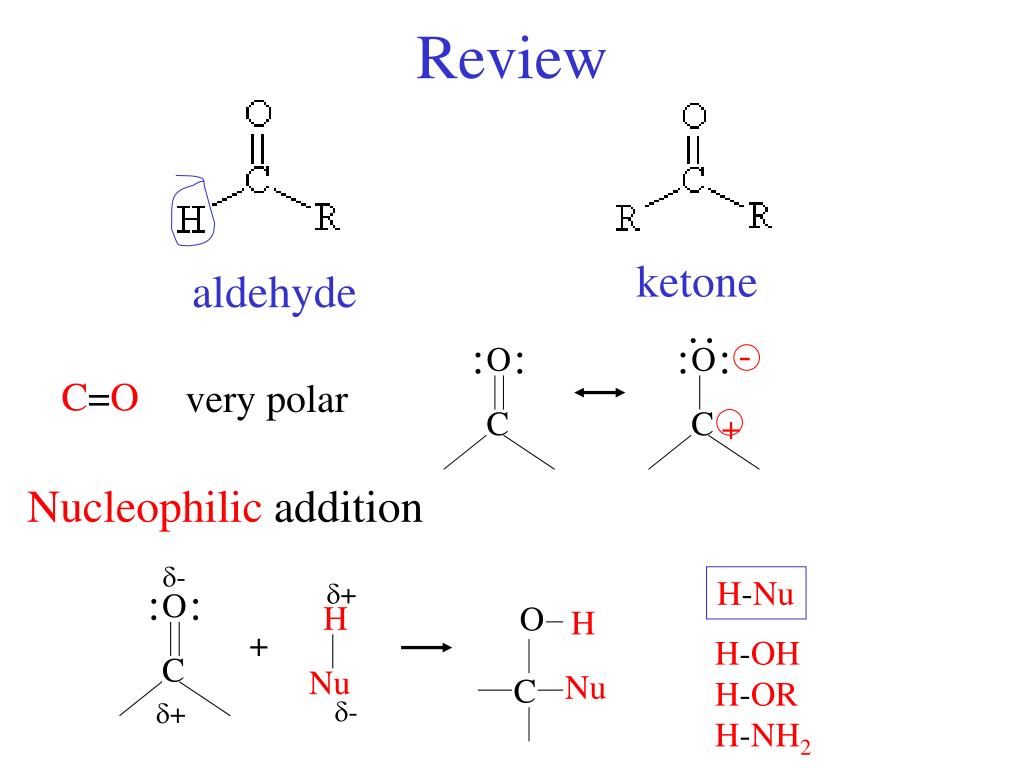
+ - : : : : : : : O O O C C C O H H Nu Nu C Review ketone aldehyde C=O very polar Nucleophilic addition - H-Nu + + H-OH H-OR H-NH2 - +
R R .. .. C O C O R R H H .. .. R C O-H R O-H R R R .. .. .. C = O C = O C = O .. .. .. R R R .. O H H .. R R R + H+ R .. C + H2O O .. .. C R R H O - H C R O-H N N H H H N - H2 O-R H Nucleophilicaddition H+ + H+ H H+ hydrate or diol + H+ + H-OH + H-OR hemi-ketal + H-NH2 Schiffs base
H H OCH3 CH3 H3C H3C C O C O H3C Addition of alcohol H+ CH3OH + H ketone + alcohol = hemi- ketal unstable aldehyde + alcohol = hemi- acetal unstable
H .. .. OH - CH3 - CH2 .. .. H H H H3C H3C H3C OH OH O - CH2 - CH3 C C C O - CH2 - CH3 O - CH2 - CH3 O - CH2 - CH3 H .. O - CH2 - CH3 .. substitution Nucleophilic H+ .. H+ .. + H2O hemi - acetal + H+ aldehyde alcohol alcohol acetal + + condensation reaction acetal + H2O hemi-acetal + alcohol
propanal + acetal 2 equivalents ethanol stable 2-butanone + hemi- ketal 1 equivalent methanol unstable
H+ + cyclohexan one ethane diol H + H2O .. H+ .. .. H+ .. + H+ ketal hemi-ketal
Carboxylic acids [O] [O] 1o alcohol aldehyde carboxylic acid methanol methanal methanoic acid H-bond acceptor - very high b.p. H-bond donor - + 2 H-bonds / molecule
Carboxylic acids Nomenclature 1. Carboxyl group (COOH) always C1 2. Family name is longest C chain with COOH 3. Suffix is “-oic acid” 4. Carbonyl groups (C=O) called “oxo” Hydroxy groups (OH) called “hydroxy”
O OH CH3 – CH2 – CH – C CH2 – CH3 CH3 – CH2 – CH – CH2 – CH – CO2H OH O CH2 – CH3 Carboxylic acids 4 3 2 1 2-ethyl butan oic acid 2-ethyl 4-hydroxy 6 5 4 3 2 1 2-ethyl- 4-hydroxy hexan oic acid 2-ethyl- 4-oxo hexan oic acid add [O]
Carboxylic Acids Chemical properties = = OH Bronsted acid H+ donor C=O + HA H+ + A- H+ + weak acids, small dissociation Ka = [A-] [H+] Ka 1 x 10⁻⁵ pH 2.5 for 1M [HA]
Carboxylic Acids H+ + H+ + - resonance structure anion stabilized
- Carboxylic Acids acidity also affects solubility soluble short chain acids H-bonding long chain acids insoluble benzoic acid LDF soluble add a strong base (OH-) ion-dipole
Reactions Acid-base reactions: + NaOH Na+ + H2O octanoic acid insoluble sodium octanoate + water soluble
Reactions Reduction: LiAlH4 5 4 6 3 1 2 5-oxo hexanoic acid hexanediol 1,5- H2/ Pt NaBH4 5-hydroxy hexanoic acid