Exploring the Byzantine Empire and the Kievan Rus: Foundations of Early Christianity
150 likes | 278 Vues
This study guide delves into the key aspects of the Byzantine Empire and the Kievan Rus, highlighting important figures like Justinian I and Theodora, as well as the influence of Christianity in early Russian history. We will examine the cultural, political, and religious dynamics that shaped these regions from the 5th to the 15th centuries, including significant events like the fall of Constantinople and the spread of the Cyrillic alphabet. Understanding these historical contexts will enhance our appreciation of their lasting impacts on European history and Orthodox Christianity.


Exploring the Byzantine Empire and the Kievan Rus: Foundations of Early Christianity
E N D
Presentation Transcript
Kick OffSeptember 20, 2013 Define the following vocabulary words on your index cards: • Byzantine Empire (p 347) • Justinian I (p 348) • Theodora (p 348) • Icon (p 350) • Orthodox Church (p 351) • Rus (p 357)
Justinian I • Reigned 527-565 AD • Wanted to recreate Roman Empire • Re-conquered Italy and N. Africa • Faced down rebellion with wife Theodora • Justinian’s Code– organized old laws and added his own
Byzantine Empire • Lost land after Justinian, kept Asia Minor & Constantinople • Emperor seen as chosen by God, spiritual and political power • Centered on Greek culture, Christianity • Iconoclast movement • 1054 schism • East – Orthodox, west- Roman Catholic Church
Constantinople • Center for East-West trade until 12th Cen. • Many beautiful buildings: palace, Hippodrome • Hagia Sophia – church built w/ dome on 4 pillars, many windows under dome, appeared to float • Invasions by Turks overwhelmed Byzantines • 1096- European Christians went on a ‘crusade’ to help fight the Turks who were also Muslim…thus it became a HOLY WAR. (we will come back to this!!!!) • 1453 – Constantinople falls to Ottoman Turks • Changes name to Istanbul
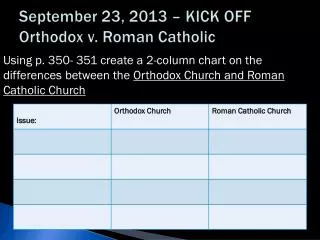
Orthodox v. Roman Catholic Using p. 350- 351 create a 2-column chart on the differences between the Orthodox Church and Roman Catholic Church
After the Quiz… • Read pages 357 – 360 and complete the graphic organizer.
The Kievan Rus Objective: Analyze how the Rus affected the early history of Kiev, the factors that helped establish Christianity in Russia, and what people groups attacked Russia.
Beginnings and Growth: (add all in yellow to notes) • Russian Primary Chronicle tells of the early Slavic peoples, written in 1100s, telling of the people in mid-800AD • Constant fighting, invited the Rus (northern Europeans) to govern • Oleg- 2nd ruler • expanded territory south to Kiev • attacked Constantinople • successful trade union with Byzantines • Slavic regions become formal state- Kievan Rus • Yaroslav the Wise • had religious books translated from Greek into Slavic • Russian law was codified • Regained lost territory; but was crushed when attacked Constantinople • Good relations w/ Western Europe through daughters’ marriages
Christianity in Russia • Early Slavic religion- polytheistic based on nature • 863- Cyril and Methodius- • brothers and Greek monks who used the Slavic language to convert Slavs • Developed written alphabet for Slavonic language • Called Cyrillic alphabet • Based on Greek alphabet • Vladimir I- Grand Duke of Kiev converted, married sister of Byzantine emperor • Built libraries, schools, churches • 988- Vlad made Christianity state religion of Kievan Rus • After the Great Schism- • became semi-independent of Orthodox in Constantinople • “Russian Orthodox Church”
Kievan Rus Attacked!!! • State weakened internally from land-owning princes • New Grand Prince Andrew Bogolyubsky moves central city away from Kiev (places family in Kiev) • Power no longer centralized, easy to attack • Attacked by: • 1. Mongols(from east under Genghis Khan)- 1223 and were defeated. Kiev falls in 1240 to Mongols. • Alexander Nevsky- encouraged Rus not to rebel against Mongols • Mongols didn’t destroy as much as they did elsewhere as a result • 2. Swedes (from north) in 1240 for trade routes • Alexander Nevsky- surprise attack on Swedes, Rus won! • 3. Teutonic Knights (Germanic military order)- • wanted Rus to convert to Catholicism • 1242- Alex. Nevsky saves Rus again by a “massacre on ice” • 4. The Tartars- ruled Rus after Mongols, until 1480 • Central Asian nomads, spoke Turkish, were Muslims,