Reconstruction and Jim Crow: Historical Overview
550 likes | 639 Vues
Learn about post-Civil War America with topics such as Reconstruction policies, amendments, African American leaders, and the rise of Jim Crow laws. Discover key events and figures that shaped this pivotal period in U.S. history.


Reconstruction and Jim Crow: Historical Overview
E N D
Presentation Transcript
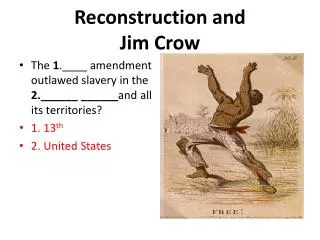
Reconstruction and Jim Crow • The 1.____ amendment outlawed slavery in the 2.______ ______and all its territories? • 1. 13th • 2. United States
Reconstruction and Jim Crow • The 3.____ amendment granted citizenship to former slaves and guaranteed 4._______ _________ under the law? • 3. 14th • 4. Equal protection
Reconstruction and Jim Crow • The 5.____ amendment guaranteed the right to vote for all 6.________ ________ men. • 5. 15th • 6. African American
Reconstruction and Jim Crow • Reconstruction involved harsh 7._____________ that created problems in the South after the 8.________________. • 7. Policies • 8. Civil War
Reconstruction and Jim Crow • Reconstruction gave meaning to the 9.________________ that former enslaved Africans had achieved during Reconstruction. • 9. Freedom
Reconstruction and Jim Crow • During Reconstruction 10._______ _________ could hold public office, while southern 11._______ _________ could not hold public office. • 10. African Americans • 11. Military leaders
Reconstruction and Jim Crow • The 12._____________ gave equal rights to African Americans during 13.__________. • 12. Civil Rights Act of 1866 • 13. Reconstruction • Who enforced it? • Northern Troops
Reconstruction and Jim Crow • The 14._____________ helped former 15._______________ African Americans during reconstruction. • 14. Freedmen’s Bureau • 15. Enslaved
Reconstruction and Jim Crow • The 16._____________ were created to limit the rights of African Americans. • 16. Black Codes
Reconstruction and Jim Crow • Reconstruction ended in 1877 after the 17.__________ and the rights that African Americans gained were lost through 18.______ laws enacted by Southern states. • 17. Election of 1876 • 18. “Jim Crow”
Reconstruction and Jim Crow • 19. _____________ was the first president of Washington College? He believed that southern states should reconcile with the south and reunite as Americans. • 19. Robert E. Lee
Reconstruction and Jim Crow • 20._________________ was the African American leader who fought for voting rights. • 20. Frederick Douglass
Reconstruction and Jim Crow • Abraham Lincoln believed in 21._______ and preservation of the union. • 21. Reconciliation
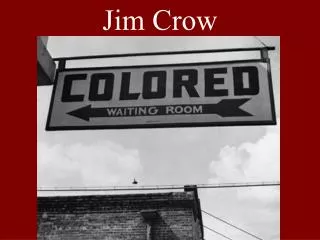
Reconstruction and Jim Crow • The 22._____________ Laws made segregation legal. They were directed primarily against 23.__________, but other groups were also discriminated and segregated. • 22. “Jim Crow” • 23. African Americans
Reconstruction and Jim Crow • 24.________________ believed that African Americans could reach equality through a vocational education and he accepted social separation. • 24. Booker T. Washington
Reconstruction and Jim Crow • 25. ________________ believed in full political, civil, and social rights for African Americans. • 25. W.E.B. DuBois
Great Plains and Westward Expansion • 26. _________ invented the steel plow and it was used to 27._______ up the hard soil, the soil was so hard because there was very little 28.__________. • 26. John Deere • 27. Break • 28. Rainfall
Great Plains and Westward Expansion • 29. Describe the environment of the Great Plains… • Flatlands that rise gradually from east to west • Land eroded by wind and water • Low rainfall • Frequent dust storms
Great Plains and Westward Expansion • 30. List the inventions that made life possible on the Great Plains… • Barbed wire • Steel plows • Dry farming • Sod houses • Beef cattle raising • Wheat farming • Windmills • Railroads
Great Plains and Westward Expansion • Reasons for 31.__________________ EXPANSION • 31. WESTWARD • a. opportunity for 32._______________________ through the Homestead Act (1862) • 32. Land Ownership • b. 33.________________ Advances such as the transcontinental railroad • 33. Technological • c. possibility of 34._________________ with discovery of gold and silver • 34. Wealth • d. 35.__________________ • 35. Adventure • e. A new beginning for 36.______________________________ • 36. Former Slaves
Great Plains and Westward Expansion • 37.________________ were forcefully relocated to 38.________________ which were areas of land were set aside for Native Americans • 37. American Indians • 38. Reservations
Great Plains and Westward Expansion • 39. ________________ was an Apache warrior who fought the American government. • 39. Geronimo
Great Plains and Westward Expansion • 40. ________________ attempts to change the lifestyle of the Native Americans which included; (reduction of the 41._____________ population) • 40. Assimilation • 41. Buffalo
Great Plains and Westward Expansion • Native Americans had their homelands reduced through 42._________________ that were broken • 42. Treaties
Great Plains and Westward Expansion • 43.________ ________ led the Nez Perce who had to flee to Canada after a few young Nez Perce killed American settlers and he stated that he would “fight no more forever”. His people were moved to a reservation. • 43. Chief Joseph
Great Plains and Westward Expansion • The 44._____________ is where Custer and his men were killed by the Sioux (Sitting Bull). • 44. Battle of Little Bighorn
Immigration and Urbanization • Reasons for Increased IMMIGRATION • a. Hope for 45._____________________ • 45. Better opportunities • b. 46.________________________ • 46. Adventure • c. Escape from 47._________ ________ • 47. Oppressive Government • d. 48._____________ Freedom • 48. Religous
Immigration and Urbanization • The 49.____________ and 50.____________ were 2 groups immigrants being discriminated against. • 49. Chinese • 50. Irish
Immigration and Urbanization • The 51._____________ Act banned Chinese from immigrating to the U.S. for 10 years. • 51. Chinese Exclusion
Immigration and Urbanization • Reasons cities grew: • a. specialized 52._______________ such as steel in 53.______________ and meatpacking in 54.________________ • 52. Industries • 53. Pittsburgh • 54. Chicago • b. 55.__________________ coming from other countries • 55. Immigrants • c. movement of Americans from 56.________to 57.________ areas due to mechanization • 56. Rural • 57. Urban
Immigration and Urbanization • 58. Who invented mechanical uses of electricity? • 58. Thomas Edison
Immigration and Urbanization • 59. Who invented the telephone service? • 59. Alexander Graham Bell
Immigration and Urbanization • 60. Who invented the first settlement house, The Hull House? • 60. Jane Addams
Immigration and Urbanization • 61. Explain what tenements were. • 61. Poorly built, over crowded, unsafe apartment buildings…
Industrialism and Big Business • Reasons for the Growth of Industry: • a. access to raw 62.________ and energy • 62. Materials • b. new 63._______________ • 63. Inventions • c. availability of a 64._____________ • 64. Workforce • d. 65.___________________ resources • 65. Financial
Industrialism and Big Business • Reasons for growth of big business: • a. captains of 66.________________ • 66. Industry • b. 67. ad________________ • 67. advertising • c. 68.______________ advances which helped with national markets • 68. Transportation • d. lower cost 69.____________ • 69. production
Industrialism and Big Business • Captains of Industry: • John D. Rockefeller-70.__________ • 70. Oil • Andrew Carnegie-71.__________ • 71. Steel • Henry Ford- 72.____________ • 72. Automobile • Cornelius Vanderbilt-73._____________ • 73. Railroad and shipping
The Progressive Era and Unions • Negative effects of Industrialization: • -74.______________ labor • Child • -Low 75. _______and long 76._______ • 75. Wages • 76. Hours • -Unsafe 77._________________ • 77. Working Conditions
The Progressive Era and Unions • The 78._____________ Movement worked to improve 79.__________ 80.__________, place restrictions on child labor, and reduce 81.________ ________. • 78. Progressive • 79. Safety • 80. Conditions • 81. Work Hours
The Progressive Era and Unions • The 82.___ Amendment gave women the right to vote. • 82. 19th
The Progressive Era and Unions • Elizabeth Cady Stanton and 83.___________ ____ ______________ worked for women’s suffrage. • 83. Susan B. Anthony
The Progressive Era and Unions • The 84.___________ Movement worked to ban alcohol. The 85.____ Amendment banned alcohol and the 86.____ Amendment made alcohol legal again. • 84. Temperance • 85. 18th • 86. 21st
The Progressive Era and Unions • The American Federation of Labor is an example of a 87.________________ who fought for the rights of workers. • 87. Labor Union
Spanish-American War • Reasons U.S. gets involved in Spanish-American War • a. Protection of American business interests in 88.__________ • 88. Cuba • b. American support of Cuba to gain independence from 89._________ • 89. Spain • c. U.S. citizens living in 90.________________ • 90. Cuba • d. rising tensions as result of sinking of the 91.________________ • 91. USS Maine • e. exaggerated new stories or 92.__________ ___________, where the condition Cubans in being exaggerated • 92. Yellow Journalism
Spanish-American War • U.S. emerges as a 93._______________ following the Spanish-American War. • 93. World Power
Spanish-American War • The U.S. receives Puerto Rico, 94._______________, and the 95.________________. • 94. Guam • 95. Philippines
The Roosevelt Corollary • The 96.____________ to the Monroe Doctrine asserted that the 97.__________ had a right to 98___________ in other countries economic affairs in the Americas. • 96. Roosevelt Corollary • 97. United States • 98. Interfere
The Roosevelt Corollary • Claimed the right for the 99._____ _____ to exercise international 100._______ ________ • 99. United States • 100. Police Power
The Roosevelt Corollary • Advocated 101.(_____ ______ __________) ~ Building of the 102.______________. • 101. Big Stick Diplomacy • 102. Panama Canal
WWI • The U.S. wanted to remain 103.______________ or__________________ at the beginning of World War I. • 103. Neutral or Isolated