Barcodes for collections
Explore the various aspects of barcode implementation for collections, emphasizing the use of Code 39. This barcode type allows for unique identifiers, comprising capital letters and numbers, making it ideal for herbaria and collections management. The guide covers the basics of barcode generation, use in labeling, and the operation of barcode readers without requiring complex software setups. Essential tips for testing and mass production ensure your barcoding process is efficient and straightforward.

Barcodes for collections
E N D
Presentation Transcript
Barcodes for collections @BARCODES@ Francisco Pando de la HozReal Jardín Botánico, Madrid Pando@ma-rjb.csic.es
Barcodes for what • Tool for management by making some tasks easier Pando@ma-rjb.csic.es Barcodes
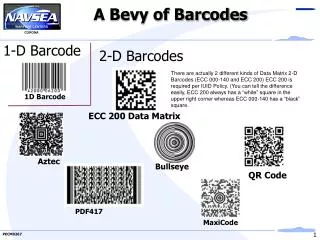
Barcodes come in different types • Different kinds of barcodes (symbologies) • The one choosen by herbaria and other collections is called “barcode 39”: • No overlaping characters (bars) • Allows letters (capitals only) and numbers • Available as a “TrueType” font: • Escalable • Portable
Code 39 • Barcode 39 allows: • Produce and use our barcodes ourselves • produce and labels with normal text and barcodes in one step Pando@ma-rjb.csic.es Barcodes
Barcodes for labels Pando@ma-rjb.csic.es Barcodes
Barcodes for labels (2) Pando@ma-rjb.csic.es
How we use barcodes • What you see: @MA 435267@ • What there is indeed: @MA 435267@ • What we put into the barcode: a unique identifier (in the world) Pando@ma-rjb.csic.es Barcodes
Barcode reader and its setup • Reader sends keystroke codes; the PC does not know if the codes come from the keyboard or the reader • No software • No configuration PC Barcode reader Duplicator Keyboard Pando@ma-rjb.csic.es Barcodes
Final remarks • It is not needed to have a barcode reader to start barcoding • Always add the text in the barcode in human-readable form • Test your barcodes before producing them in mass (final size and spacing between characters depens on paper and printer quality, and type of barcode reader) Pando@ma-rjb.csic.es Barcodes