The Photoelectric Effect: Wave or Particle? An Overview of Key Concepts and Experiments
100 likes | 236 Vues
The photoelectric effect illustrates the dual nature of light, acting as both a wave and a particle. In experiments, X-ray machines hit targets with electrons, producing electromagnetic radiation, while shining monochromatic light on a target results in the ejection of electrons, called photoelectrons. The current produced can be influenced by light intensity and frequency, but only above a certain cutoff wavelength do photoelectrons respond. The relationship between energy, frequency, and work function highlights the quantum nature of light, as discovered by Einstein in 1905, earning him the Nobel Prize.


The Photoelectric Effect: Wave or Particle? An Overview of Key Concepts and Experiments
E N D
Presentation Transcript
The photoelectric effect To be a wave or a particle? That is the question.
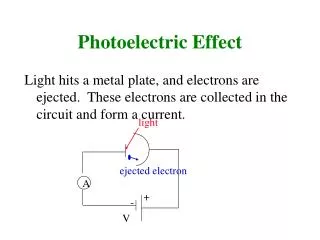
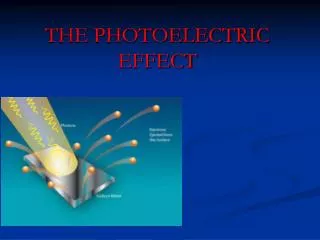
Quick overview: • X-ray machine hits target with electrons and EM radiation flies out • In the photoelectric effect, you hit target with EM radiation and electrons fly out! • The electrons ejected from the target are called “photoelectrons”
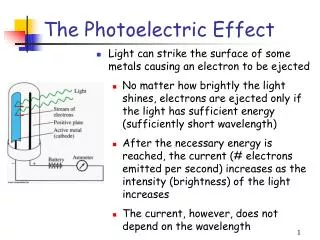
The setup • An adjustable voltage is applied. Voltage can be forward or reverse biased (which slows down the electrons) • Photoelectrons return to cathode through an ammeter which records the current
Some experimental results: • If photoelectrons get ejected when you shine monochromatic light on the target, the current increases when you increase the intensity (brighter light = more photoelectrons) • BUT…above a “cutoff wavelength” no photoelectrons get ejected no matter how great the intensity of the incident radiation • AND…for wavelengths below the cutoff, decreasing the radiation to very low intensities does not completely eliminate the production of photo electrons
High intensity (bright) Stopping potential Low intensity (dim) Current vs. Bias voltage Reverse bias Forward bias
Stopping voltage vs. Frequency (c/l) eV(stopping) frequency
Interpretation • Slope is same for all targets • y intercept is different for different target materials. • eDV=hf - fmetal • f is the “work function” of the metal…the mininum amount of energy required to remove an electron. • h=6.63 x 10⁻³⁴ is Planck’s Constant!
Interpretation (continued) • Planck’s EM “quanta” turn out to be real after all! (?) • Light comes in energy packets equal to hf • Each packet acts more like a particle than a wave • These light “particles” are called photons • Rather than continuously absorbing wave radiation the target is being bombarded by photons like tiny billiard balls!
Concluding statements • Einstein figured out the photoelectric effect in 1905 (the same year he developed the theory of special relativity and explained Brownian Motion). This is what he got the Nobel prize for. • I like to think of the the photoelectric equation in terms of conservation of energy light energy ejecting electron & KE KE eDV hf = f + KE = f + eDV
Parting question... So is light a particle? Or is light a wave?